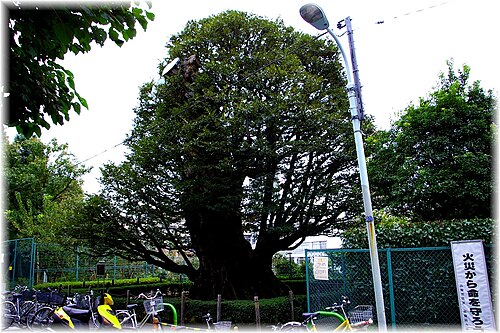
Eight metres around and barely eleven tall, this chinquapin is built like a barrel.
Photo: Originally uploaded by Tokyo Watcher (move approved by User:LERK) (CC BY-SA 3.0)
Castanopsis sieboldii
Sudajii, the Japanese chinquapin, was the dominant tree of the evergreen broadleaf forest that once covered lowland western Japan, before it was cleared for rice, timber and capital cities, so a mature one standing inside a city today is a leftover of the landscape the city replaced. We map 4 of them, in 4 cities.
Kyoto's grows at the Omiya gate of Kyoto Gyoen, on ground that outlasted the forest around it. Kanazawa's pair flank the entrance of the old Ishikawa prefectural office, made a National Natural Monument in 1943, built low and broad rather than tall. Tokyo's, roughly four hundred years old and eight metres round, grows on the former Hosokawa estate where Oishi Kuranosuke is said to have been held after the Ako Incident of 1701.
Eight metres around and barely eleven tall, this chinquapin is built like a barrel.
Photo: Originally uploaded by Tokyo Watcher (move approved by User:LERK) (CC BY-SA 3.0)
Before there was a city here, this was the tree that covered the ground.
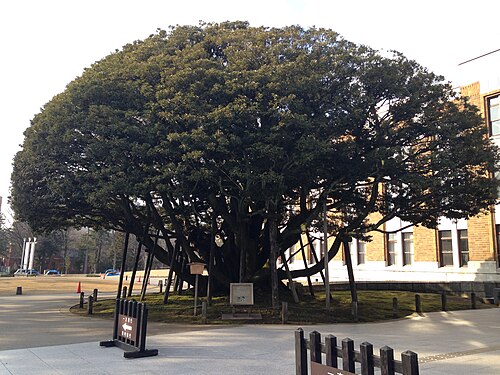
Two of them stand either side of a doorway, and they do not so much stand as sit.
Photo: そらみみ (CC BY-SA 4.0)
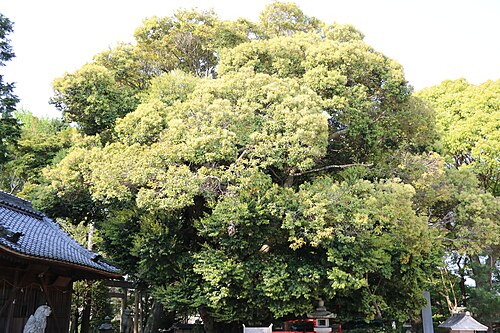
The main trunk of this tree died.
Photo: さかおり (CC BY-SA 4.0)
Explore by city: Tokyo · Kyoto · Kanazawa · Prague · Brussels · Seville · Munich · Porto · every city · or browse all species.