Morioka maps two trees, both national monuments and both born from disaster. Ishiwari-zakura, a cherry rooted in a cracked granite boulder at the district court, survived a 1932 fire when a gardener wrapped its trunk in his own wet coat. Twelve kilometres out at Ryugen-ji, a weeping katsura grows from a stump: the temple's original, over thirty metres tall, was felled for timber in 1824, and what stands now is the sucker that came up after. Both have carried National Natural Monument status since the 1920s.
0 of 2 visited in Morioka
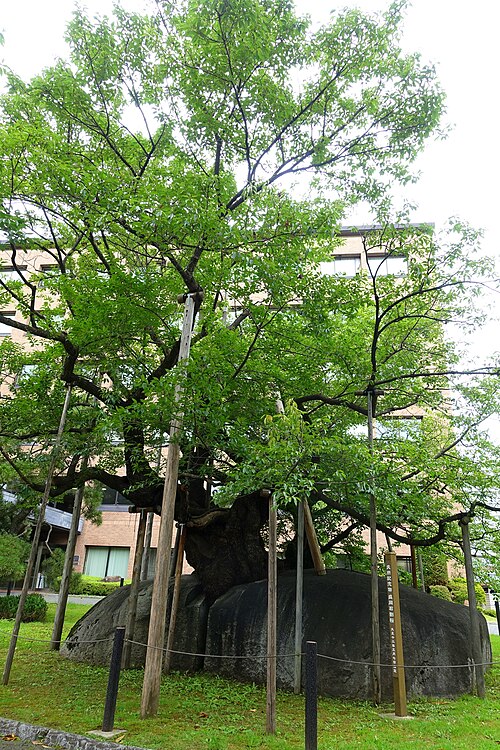
Edo Higan Cherry (Prunus itosakura, syn. Cerasus spachiana) · 380 years · Uchimaru
In 1932, fire tore through part of the Morioka District Court, and it looked as though it would take the cherry tree growing in the boulder in front of the building with it. A gardener named Fujimura Jitaro wrapped the trunk in his own wet coat rather than let it burn. It bloomed again the following spring.
The tree was already unusual before the fire. Legend says lightning split the granite boulder it grows from, and a cherry seed caught in the crack afterward, though nobody knows for certain how a tree ended up rooted half inside solid rock. What is certain is the result: a trunk about 4.3 metres round at the point where it meets the stone, forcing its way out of a fissure that offers it almost no soil.
Japan designated it a National Natural Monument in 1923, one of the earliest trees to receive that status, and the courthouse still keeps the grounds open daily so the public can walk up and see it, dogs excepted. It is judged to be somewhere between 350 and 420 years old, and every April, for the roughly ten days it is in bloom, the court adds bus parking for the crowds. A functioning court of law that also runs a car park for cherry blossoms is not a common combination, and it says something about how seriously the tree is taken here.
Katsura (Cercidiphyllum japonicum), weeping form · 200 years · Ohgayu, Morioka
The tree standing here exists because the one before it was cut up for the roof. By 1824 the old weeping katsura at Ryugen-ji had passed thirty metres, and the temple felled it for timber to repair the main hall. A sucker came up off the stump. That sucker is what you walk to now, about twenty-one metres tall and 3.5 metres round at chest height, and the two centuries it has been growing are the shortest part of its story.
The rest runs backwards. A weeping katsura, a rare variant of an otherwise ordinary species, was found growing wild in the mountains of Uchikawame roughly four hundred years ago. It was moved first to Myosen-ji, then moved again to Ryugen-ji by the priest who founded the temple in 1574. In 1924 Japan designated it a national Natural Monument together with two clonal sisters elsewhere in Morioka, all three counted as one monument under one name.
One thing to know about the numbers. The height and girth above come from a Morioka board of education sign put up in 1994, and every later source quotes that sign. It is one measurement repeated, not two that agree. A photograph from May 2018 shows the tree alive and in full leaf.
It grows behind the main hall at the edge of the graveyard, on the grounds of a working Soto Zen temple. No gate, no fee, and no station: Ohgayu is rural, and you arrive by car.