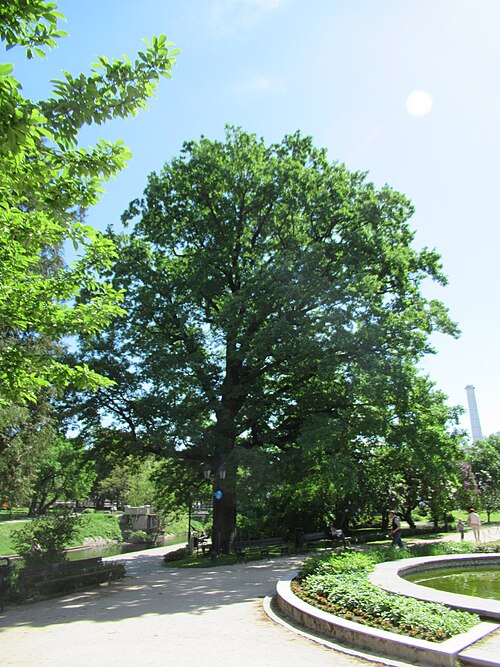
A rowan grows out of this linden, rooted in the fork where the trunk divides. It is the thickest linden in Riga and among the two or three most voluminous trees of any species in the city, protected as a heritage tree of state significance. Its trunk is also one of the best documented in Latvia. The dendrologist Atis Baiža measured it at 5.34 metres round in 1975. By 2009 the figure was 6.82 metres at 1.2 metres up, a metre and a half added across thirty-four years, which is a tree still working rather than a name on a register. It stands 26 metres tall over a crown covering some 350 square metres. The age is the softest number here. Guntis Eniņš's 2008 survey of Latvia's greatest trees gives approximately 200 years and nobody has tightened it since, so take that loosely. The linden grows on Lucavsala, a Daugava island now held as public forest and crossed by walking trails, and it stands near the monument to the Russian soldiers who fell there in the Great Northern War in 1701. That is roughly a century before this tree existed. It arrived late to its own setting, and has outgrown everything in it since.
In bloom
July to August, when it flowers
The line is our estimate of how much there is to see, not a measurement. Typical for this species where this tree stands; exact weeks shift with the year.
Lucavsala island, near the monument to Russian soldiers fallen in the Great Northern WarYou can recognise it by the rowan growing out of the fork where its trunk divides. It stands on Lucavsala island, near the monument to the fallen Russian soldiers.
Free, public island park with walking trails (Rigas Meži recreation area); reachable on foot
Bus/tram to Kipsala or Torņakalns then walk across the Lucavsala footbridge, approx 15-20 min walk from nearest stop
Sources
Where the facts on this page come from.