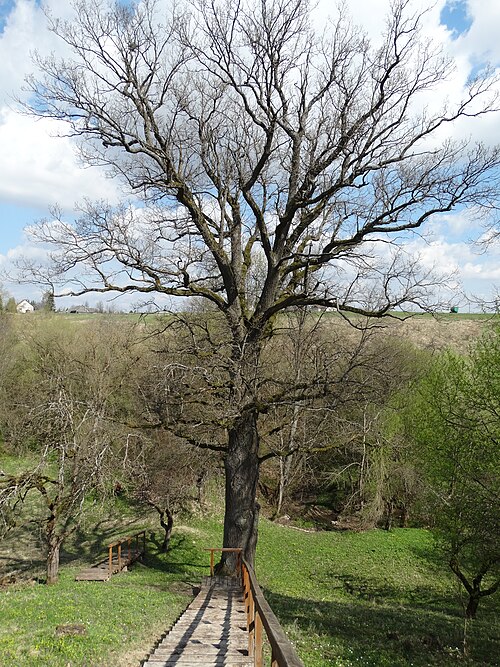
The Beautiful Oak of Plauginiai Forest
Lithuania signposts this oak by name from the public highway, three and a half kilometres before you get to it. Gražusis ąžuolas, the Beautiful Oak. What waits at the end of the gravel road is a 400-metre interpretive trail built for one tree, with carved oak sculptures along it, a rest area with a pavilion and a fireplace, and a wooden acorn at the foot of the trunk carved with the tree's own measurements. The state forest service assessed it on 8 June 2017 and recorded 32 metres of height, 5.8 metres of girth at chest height and a condition of excellent. A local news report the following spring gave 5.8 metres and 33 metres, matching the acorn. Back in 1985 the figures were 28 metres and a diameter of 1.4 metres, so it has put on both height and thickness since somebody last got out the tape. It has been a nature monument since 1960 and was raised to republic-level significance in 1985, which is when the state decided this particular oak in the Plauginiai forest reserve was worth pointing traffic at. Its age is given as about 300 years by every source that mentions one, the wooden acorn included, and not one of them says where the number comes from. Nobody we can find has dated it properly. If you know who has, tell us.
From people who stood here
No notes yet
Did you visit the tree? Leave a note for the next visitor.
Getting there
Plauginiai forest, near Bedančiai, Šiluva parish, Raseiniai District, Lithuania (within the Plauginiai botanical-zoological reserve, Dubysa Regional Park)
You can recognise it by the carved wooden acorn at its foot and the 400-metre trail of sculptures leading to it. It stands at the end of a signposted forest road in the Plauginiai reserve.
Free and genuinely public: a state forest reserve reached via a signposted gravel forest road off road 148 (Raseiniai-Siluva), 3.5 km to a marked pull-in, then a purpose-built 400 m interpretive nature trail leads to the tree. Oak sculptures, a rest area with a pavilion and a fireplace, and a carved wooden acorn marker with the tree's own stats stand at the site, so this is an actively maintained, signposted tourist stop rather than a hidden spot.
No public transport; reached by car via road 148 between Raseiniai and Siluva, then the signposted forest gravel road (3.5 km) and a 400 m walk on the interpretive trail.
In fruit
September to October: acorns drop, and a good mast year buries the ground in them
The line is our estimate of how much there is to see, not a measurement. Typical for this species where this tree stands; exact weeks shift with the year.
Sources
Where the facts on this page come from. The story was written with AI from these sources, and readers who know the tree correct it.