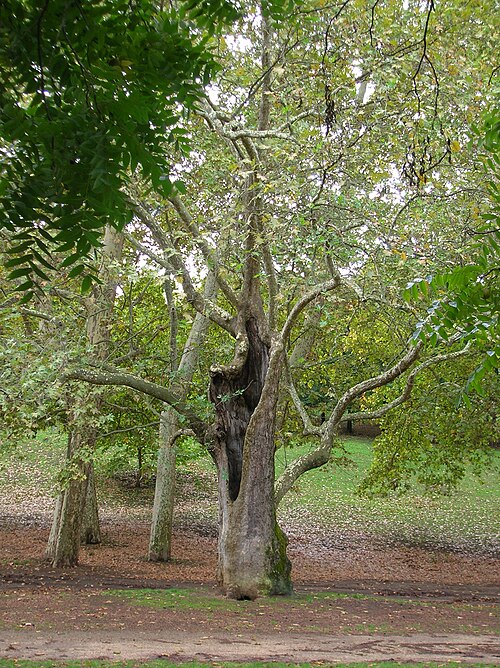
Photo: Patafisik (CC BY-SA 3.0)
Nine trees are what remain of the eleven Cardinal Scipione Borghese planted here four centuries ago.
Cardinal Scipione Borghese built this park in the early 1600s as a showcase for his art collection, and his gardener planted the trees to match: oriental planes brought in as a novelty, arranged in a valley that still carries their name.
Adonis, the oldest of them, has stood here for over four centuries and outlived the villa's original owner by nearly as long. A cedar leans over the lake a few minutes' walk away, and past the boating lake stands what one conservation group calls the last survivor of the eighteen cypresses planted around Piazza di Siena in 1789, the arena that still hosts Rome's international horse show every year. Deeper into the park's holm oak wood, behind the museum that now holds a de Chirico and Warhol collection, a pair of hackberries with a four-metre girth waits on the official monumental status that roughly thirty of the park's other old trees are still queuing for.
All 5 stand in Rome, which maps 31 remarkable trees in total.
Photo: Patafisik (CC BY-SA 3.0)
Nine trees are what remain of the eleven Cardinal Scipione Borghese planted here four centuries ago.
A hackberry in the holm oak wood behind the Museo Carlo Bilotti carries a nickname rather than a certificate: locals call it il bagolaro del Seicento, the hackberry of the 1600s, though nobody has...
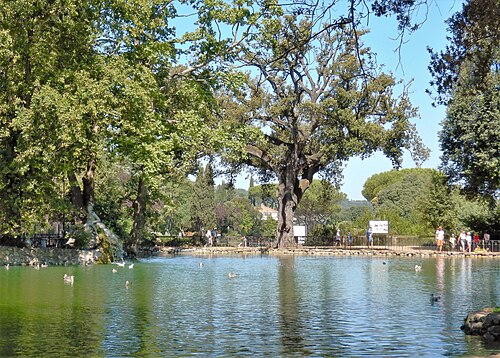
Photo: Albarubescens (CC BY-SA 4.0)
Marcantonio IV Borghese tore out six hundred holm oaks in 1784 to build an English-style garden around Villa Borghese's lake, and one tree, by luck or design, was left standing.
Eighteen cypresses once ringed Piazza di Siena when the arena was laid out in 1789, part of the original hedge and tree enclosure designed by architect Antonio Asprucci for what is now Rome's inter...
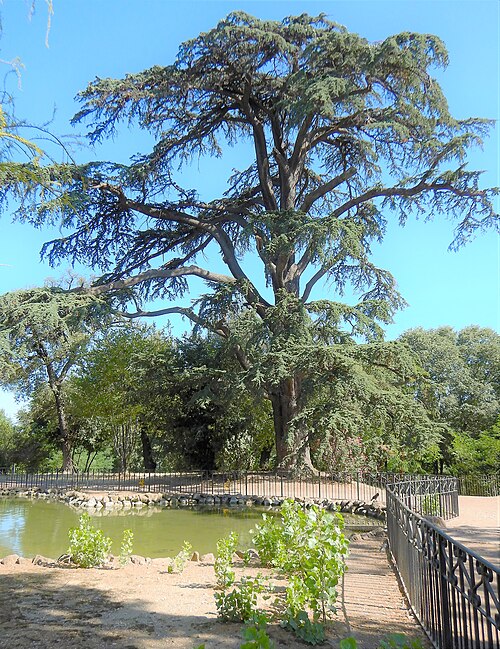
Photo: Albarubescens (CC BY-SA 4.0)
Rome's own list of monumental trees does not describe this cedar on its own.
Opening times and visitor information: the City of Rome.
More parks worth the walk: every park we map. Or explore by city: Brussels · Pamplona · Lisbon · Barcelona · Oahu · Amsterdam