Fifteen metres of girth, and almost none of it is a trunk in the ordinary sense.
Ancient Trees in Singapore Botanic Gardens
Singapore, Singapore
Singapore's Botanic Gardens opened in 1859 and earned a UNESCO World Heritage listing in 2015, not for any single specimen but for grounds that have kept unusually good paperwork on the trees growing in them.
A sausage tree arrived from Honolulu on 13 May 1931 and went into the ground that October, one of dozens of tropical trials from an era when a plant's usefulness decided its future. A cannon ball tree grew from a seed the assistant director E.J.H. Corner grabbed during a rushed eight-hour stop at the botanic garden in Peradeniya, Ceylon, the same year. A baobab, moved once in 1996 and only about forty years old, already carries five metres of girth, a fraction of the age a species that can pass a thousand years usually needs for that. A giant strangler fig by Swan Lake is registered as a Burmese banyan, though a 2024 study argues it is something else entirely, propagated here from cuttings for more than 150 years. A saga tree planted in the 1880s to smother weed grass now sits in the National Heritage Board's own art collection, photographed for a 2013 work mapping the island's saga trees. Two nutmeg trees near the old Economic Garden are what is left of the spice boom that gave Orchard Road its name. They all stand on garden ground, open daily and free to enter.
The saga was brought to Singapore to fight a grass.
Teak needs a dry season, and Singapore has never had one.
The seeds of this tree are roughly forty percent fat, and West Africa presses them for butter.
A ripe fruit on this tree is a grey-brown cylinder up to a metre long, hanging from a cord of a stalk, heavy enough that nobody sensible stands under one for long.
This tree flowers and fruits straight out of its own trunk.
This tree has a birthday.
This kapur was planted in July 1942, mid-occupation Singapore, from seed the botanist E.J.H.
This jamuju went into the ground on 30 January 1956, one of the last survivors of a conifer collection that once filled much of what is now the Tanglin Core of the Botanic Gardens.
This tree flowered and fruited three times between 1983 and 1986, then went quiet for a quarter of a century before doing it three times again between 2012 and 2014.
Singapore's first prime minister, Lee Kuan Yew, planted this Senegal mahogany himself on 2 November 1980, for what was then Tree Planting Day, a young sapling at the time and nothing like the tree...
There is a baobab in Singapore, and it is only about forty years old.
Orchard Road is named after orchards, and the crop in them was nutmeg.
You can see this tree from the Bandstand, which is odd for a tree standing inside a forest.
When Nelson Mandela came to the Singapore Botanic Gardens in 1997, the Gardens dedicated a tree to him, and they picked an unlikely one.
Forty-four and a half metres is roughly a fourteen-storey building, and that is the height of this tree, standing in the middle of Singapore.
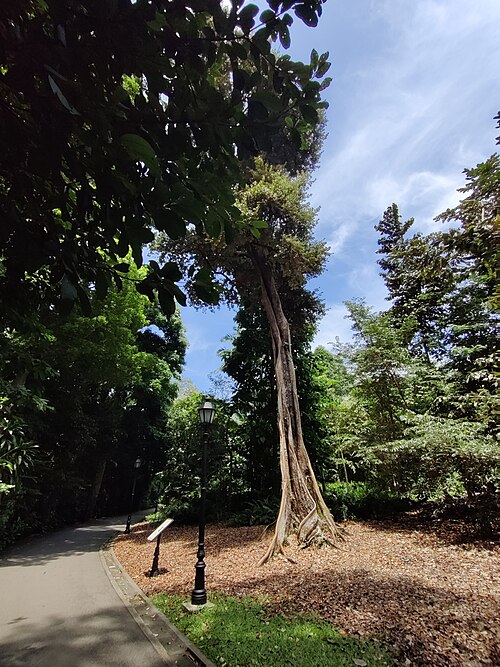
In 1908 Henry Ridley described a species new to science, and the material came off this tree.
Photo: Andy Mabbett (CC BY-SA 4.0)
The flowers smell of sour milk and the pods stink when you bruise them, which does a poor job of advertising the sweet, edible pulp inside those pods.
Thirty-five and a half metres of tree on a trunk 2.6 metres round.
Kempas trees grow plank buttresses up to six metres tall, walls of root that hold a very tall trunk upright in swamp ground that gives nothing to grip.
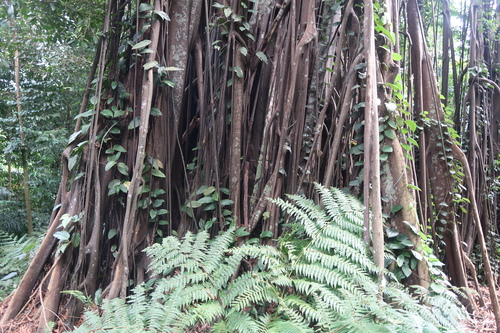
The tape goes fourteen metres around this fig, and almost none of what it measures is trunk.
Photo: Yaron Budowski (CC BY)
The Botany Centre at the Singapore Botanic Gardens was built around this tree on purpose, its floor plan bent to leave it standing exactly where it already grew.
Singapore's Botanic Gardens once held a serious conifer collection where this mountain teak now stands, planted somewhere in the decades after Superintendent N.
Nobody planted this tree.
More parks worth the walk: every park we map. Or explore by city: Prague · Brussels · Porto · Brisbane · Munich · Cambridge