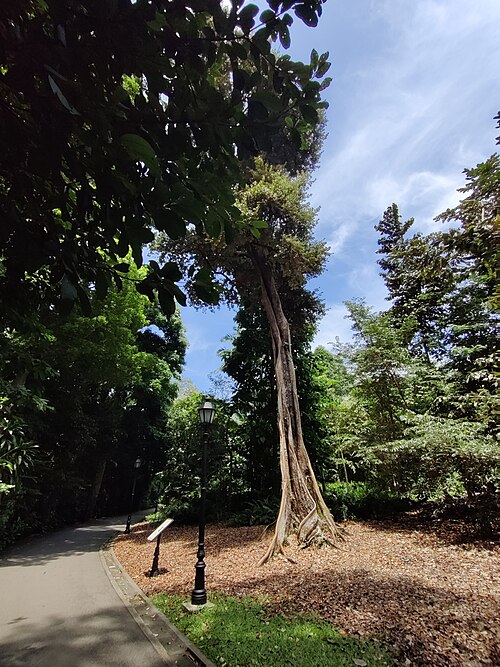
The Saga Tree of the Tanglin Entrance
SingaporeSingaporeSingapore Botanic Gardens
The saga was brought to Singapore to fight a grass. Between 1883 and 1885 the Gardens' superintendent Nathaniel Cantley planted it as an experiment in smothering lalang, the coarse weed grass that takes any cleared ground here within weeks. It worked well enough that the director Henry Ridley later used saga to shade the Gardens' nutmeg, and by the 1970s and 80s it had become a standard Singapore roadside tree. This one grows a few minutes inside the Tanglin entrance, near the Frangipani Garden. Its age comes out of a filing cabinet rather than off a tape. The earliest herbarium specimen cut from this individual tree is dated 1900, which is why the register says it must be well over a century old, putting it past 126 years now. Its measurements are less settled. NParks records a girth of 5.32 metres and a height of 13.1 metres; the National Heritage Board's own entry gives 4.8 metres and 24 metres. The height gap is far too wide to split, so treat both as claims and neither as final. What nobody disputes is the seeds, hard scarlet discs that children pocket and collectors hunt; one collector has mapped 57 saga trees across the island. This tree also sits in a national art collection, photographed by Robert Zhao Renhui for his 2013 work mapping exactly those trees.
Singapore Botanic Gardens, near Frangipani Garden / the Lady on a Hammock sculpture, close to the Tanglin EntranceYou can recognise it by hard scarlet seed discs on the ground beneath it. It stands a few minutes inside the Tanglin Entrance, near the Frangipani Garden and the Lady on a Hammock sculpture.
Free entry daily; the Gardens are open 5am to 12 midnight (only the National Orchid Garden is ticketed)
Botanic Gardens MRT (Circle/Downtown lines), about 5-10 minute walk from the Tanglin Gate
Sources
Where the facts on this page come from.