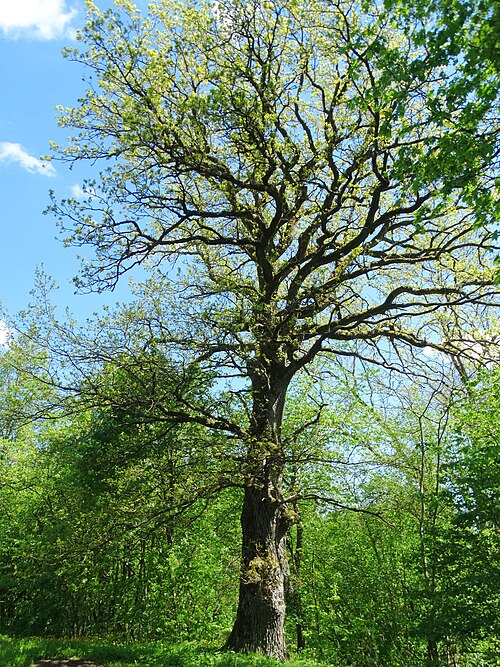
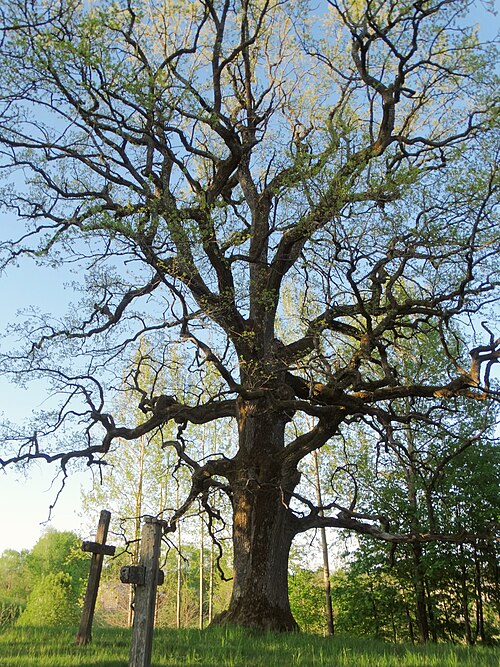
You can step through a hole in the side of this oak and stand inside it. The trunk is 6.30 metres round and almost entirely hollow, and it still comes into leaf every year. What it does not have is height. It stops at 16 metres, short for that bulk, and local tradition blames lightning, repeatedly, for taking the crown off. The same tradition gives the tree more than 600 years. Nobody has counted its rings or worked the figure out from a growth rate, so treat 600 as the village's number rather than a surveyor's. If even half of it holds, this oak was standing through the partitions of the Polish-Lithuanian state, both world wars, and fifty years of Soviet rule. Lithuania made it a state-protected natural heritage object in February 2016, by ministerial order, in the same document that covers the Geniai oak a few kilometres west. The land around it is privately owned and the tree is treated as everybody's: a wooden barrier, an information sign, arrows pointing the way in, and a position directly on the regional park's own cycling and driving route. Both records of it call it one of the most visited natural sights in the park, which for a tree with no crown left is a decent second career.
From people who stood here
No notes yet
Did you visit the tree? Leave a note for the next visitor.
Getting there
Gudlaukis village, Mazonu seniunija, Taurages district municipality, inside Pagramantis Regional Park, about 2km southeast of Pagramantis
You can recognise it by the trunk, 6.30 metres round and hollow enough to step inside through a cavity, under a broken crown only 16 metres tall. It stands behind a wooden barrier with an information sign, in Gudlaukis.
Free to see from the fence. The oak stands in a private farmyard, enclosed by a wooden barrier with an information board, reached by a good gravel road with direction arrows; it is on the park's cycling and driving route. No fee or hours published.
No public transit; reached by a good gravel road inside Pagramantis Regional Park, about 2km southeast of the Pagramantis visitor centre in Ringiai village.
In fruit
September to October: acorns drop, and a good mast year buries the ground in them
The line is our estimate of how much there is to see, not a measurement. Typical for this species where this tree stands; exact weeks shift with the year.
Sources
Where the facts on this page come from. The story was written with AI from these sources, and readers who know the tree correct it.