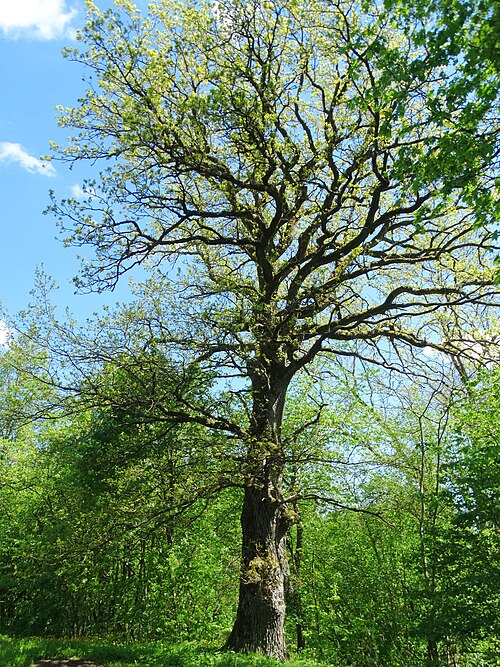
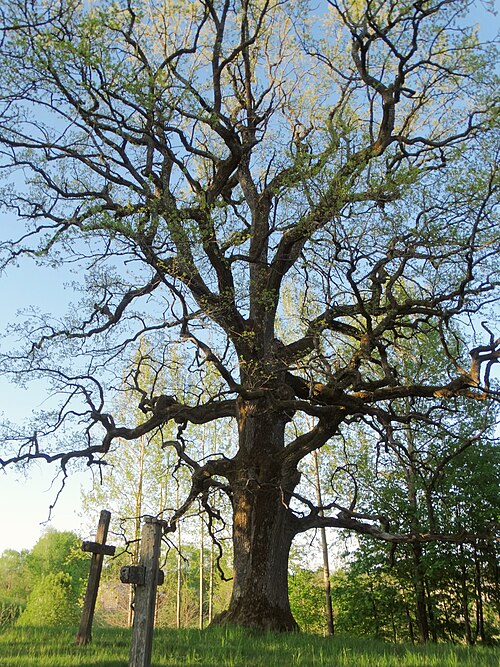
Two and a half kilometres from a hollow, lightning-wrecked oak stands the version that got away with it: the same species, the same park, nearly the same waistline, and no damage at all. The Geniai oak measures 5.8 metres round in one survey and 5.6 in the other, and reaches 26 metres in the first and 25 in the second. Nobody has reconciled the two, which is what happens when a tree is measured twice, years apart, by people who had no reason to compare notes. The Lithuanian record puts it among the largest oaks in the country, and both records agree it is in vigorous health, which at that girth is the rarer half of the sentence. It grows about 150 metres back from the right bank of the Jura, reached by a gravel road and then a stretch of meadow, with an information board and arrows to bring you in. Lithuania listed it as a state-protected natural heritage object in February 2016, in the same ministerial order that covers the Gudlaukis oak. What it does not carry is a date or a legend. No ring count, no planting record, nobody's grandfather stopping here. Oaks this thick in Lithuania generally run to several centuries, but that has never been established for this one. If you know of an age with a source behind it, tell us.
From people who stood here
No notes yet
Did you visit the tree? Leave a note for the next visitor.
Getting there
Geniai village, Mazonu seniunija, Taurages district municipality, about 150m from the right bank of the Jura river, inside Pagramantis Regional Park
You can recognise it by the trunk, 5.6 to 5.8 metres round under an undamaged crown some 25 metres tall. It stands in meadow about 150 metres from the right bank of the Jura, with an information board at its foot.
Free. Marked with an information board and direction arrows; a good gravel road, then about 200 m from the forest track at the gazebo, past a farmstead with a pond and along a field track across a meadow. No fee or hours published.
No public transit; inside Pagramantis Regional Park, about 2.5km (straight line) southwest of the Pagramantis visitor centre.
In fruit
September to October: acorns drop, and a good mast year buries the ground in them
The line is our estimate of how much there is to see, not a measurement. Typical for this species where this tree stands; exact weeks shift with the year.
Sources
Where the facts on this page come from. The story was written with AI from these sources, and readers who know the tree correct it.