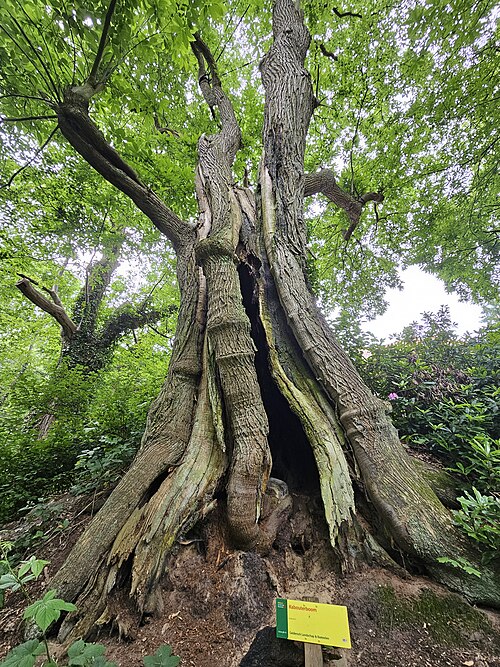
The Yew of the Bartholomeuskerkje
NetherlandsNijmegenBeek, Berg en Dal
A charter of 1286 is the first mention of the little church this tree stands beside, and the churchyard around it has been in use ever since. The building had a hard nineteenth century: shared between Catholics and Protestants from 1796, neglected by both, closed in 1824 as unsafe, and only saved when King William I put money towards its repair. The yew was there through all of it. The register records a painting by Barend Cornelis Koekkoek from about 1830 showing the church with this tree beside it, already looking like it had been standing a long while, and concludes the tree is probably older than two hundred years. That is one source making a careful argument rather than a measurement, so treat the age as an argument too. What is not in doubt is what a yew does with time. It grows slowly, hollows early, and then keeps going for centuries after the point where any other tree would have finished, which is why yews and graveyards have kept each other company across northern Europe for a thousand years. The churchyard is open, small, and quiet, and the foundation that looks after it describes it as park-like. That is fair.
In fruit
September to November: red arils on female trees, the only part that is not poisonous
The line is our estimate of how much there is to see, not a measurement. Typical for this species where this tree stands; exact weeks shift with the year.
Churchyard of the Bartholomeuskerkje, Rijksstraatweg, BeekA dark, dense yew among the headstones beside the small white church, thicker in the trunk than its height suggests.
Free. Open churchyard.
About 4.7 km east of Nijmegen centre, on the Rijksstraatweg at Beek. Bus 5 or 8.
Sources
Where the facts on this page come from.
- In the official register: Landelijk Register Monumentale Bomen (Bomenstichting), no. 1696558
- monumentalebomen.nl
- bartholomeuskerkje.nl
- nl.wikipedia.org
- services-eu1.arcgis.com