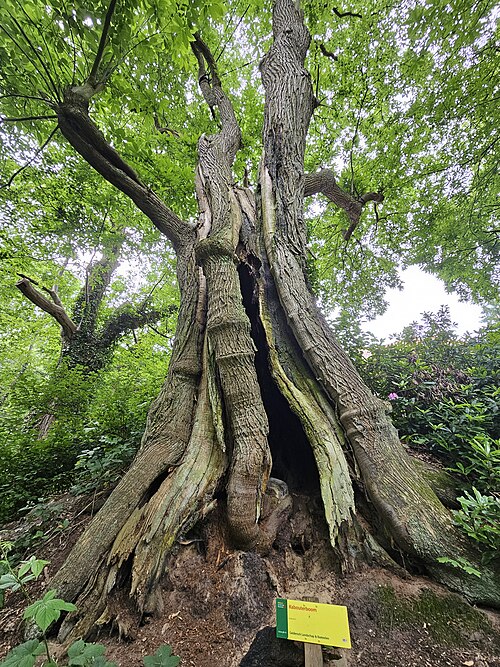
The Romans picked this spot in about 12 BC and built a fort on it, because from sixty four metres up you can see the Waal, the Ooijpolder, the Betuwe and most of the way to Arnhem. Eighteen centuries later somebody planted limes for the same view. The group stands on the hilltop at the end of a lime avenue, and the two were almost certainly planted together, the avenue as the way up to the hill. The register dates both between 1750 and 1800 and can show its working: the hill is on the Tranchot map of 1803, and both the avenue and the hill are drawn on the cadastral map of 1811. It lists the hilltop group under a category that has nothing to do with size. They are recorded as a kruisboom, a cross tree, which is what the Dutch register calls a tree planted for a religious purpose. The note says only that they may have served one, which is the honest version: nobody now knows what was meant to happen here. The register counts three at the viewpoint. Locally they are called the four apostles, which suggests there were once four, and that is the kind of arithmetic old trees usually lose.
In bloom
June to July, when it flowers
The line is our estimate of how much there is to see, not a measurement. Typical for this species where this tree stands; exact weeks shift with the year.
Kopse Hof, at the viewpoint on the Kops PlateauA tight group of very old limes on the highest point, at the top of the avenue, with the view opening north over the river.
Free. Public open ground on the Kops Plateau, reached by the lime avenue.
About 2.6 km east of the centre, a half-hour walk out along the Berg en Dalseweg.
Sources
Where the facts on this page come from.
- In the official register: Landelijk Register Monumentale Bomen (Bomenstichting), no. 1696070
- monumentalebomen.nl
- woneninnijmegen.blog
- absolutefacts.nl