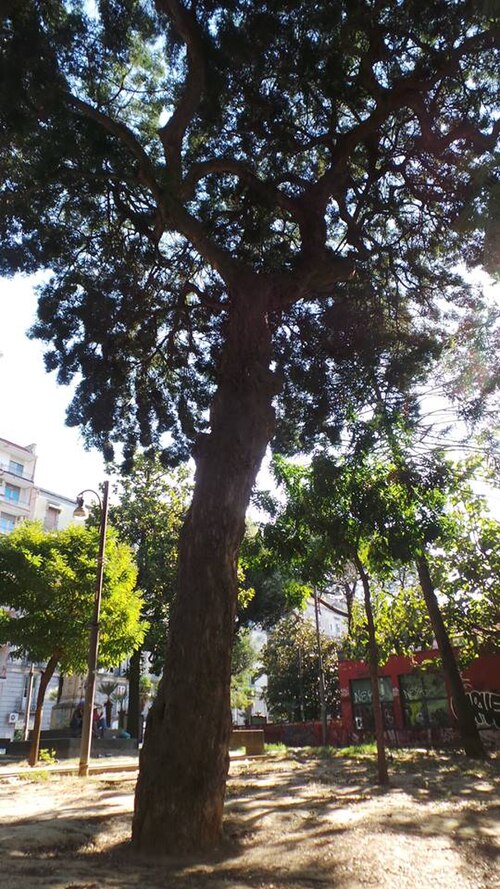
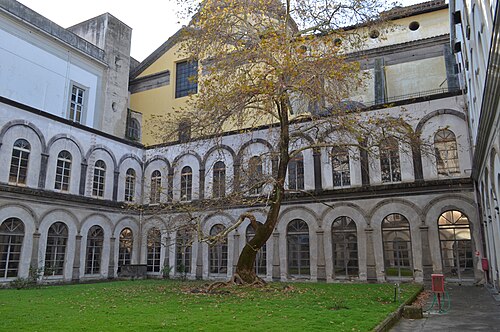
Four 16th century Neapolitan noblewomen, sisters who took religious vows together, founded the convent whose cloister now holds this holm oak, one of two trees the site is best known for alongside a camphor said to have been planted by Joachim Murat during his brief reign as King of Naples. At 24 metres, the oak is the taller of the pair and the more anonymously documented, no individual planting date or attributed founder the way the camphor has, simply a long-established presence in a cloister garden enclosed by piperno stone arcades and rows of Washingtonia palms locally reckoned the tallest in the city. The convent the sisters founded in 1580 has since become the Faculty of Medicine of the University of Campania Luigi Vanvitelli, and the cloister, once a place of enclosed religious life, now sits inside a working university building, its centuries-old wooded garden intact around students and staff rather than nuns. Quercus ilex is Mediterranean by origin, evergreen year round, and slow enough growing that a specimen this size represents a very long, very undocumented stretch of the site's history.
From people who stood here
No notes yet
Did you visit the tree? Leave a note for the next visitor.
Getting there
Complesso di Sant'Andrea delle Dame, Via Luigi De Crecchio 17, 80138 Napoli
You can recognise it as the taller of two trees the cloister is known for, standing 24 metres among piperno stone arcades and a row of the city's tallest Washingtonia palms. It stands in the Complesso di Sant'Andrea delle Dame.
Free, university building courtyard (check faculty opening hours)
10 min walk from Napoli Museo metro
Sources
Where the facts on this page come from. The story was written with AI from these sources, and readers who know the tree correct it.