Nago maps one tree: Hinpun Gajumaru, a banyan in the middle of the city whose fused aerial roots have grown too wide to measure as a single trunk. It was already old enough to appear in Ryukyuan poetry by the 1690s, and a stone marker placed at its base in 1750 gave it its modern name. A National Natural Monument since 1997, it is the acknowledged symbol of Nago City.
0 of 1 visited in Nago
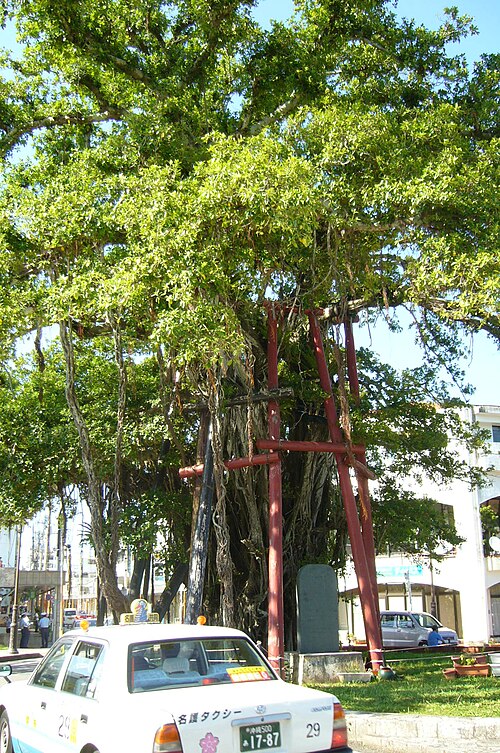
Fig (Ficus sp.) · 300 years · Central Nago
Okinawa's only railway, the Naha monorail, does not reach anywhere near this tree, and yet it is one of the most visited individual trees on the island. Hinpun Gajumaru stands beside a small plaza in the middle of Nago, a banyan whose fused mass of aerial roots has grown so wide that its exact trunk cannot be measured, only the mass itself, which comes in at nearly 12 metres around.
It was already old enough to appear in Ryukyuan poetry by the 1690s, growing beside a large pine that it gradually swallowed as its aerial roots spread and thickened around it. In 1750 the Ryukyuan statesman and feng-shui scholar Sai On placed a stone marker at its base, the Hinpun-ishi, named for the traditional Okinawan screen wall that stands between a house's gate and its entrance, and that stone gave the tree its modern name. A 2002 typhoon tore branches from the crown, and a 2010 conservation prune removed nearly a tonne of damaged wood to keep the tree stable.
Okinawa Prefecture protected it in 1956, and Japan made it a National Natural Monument in 1997, one of the country's highest tiers of heritage protection. It is the acknowledged symbol of Nago City today, and unlike almost everything else this far south in Okinawa, you do not need a car once you are in town: it stands in the open, beside a public road, visible to anyone who walks past.
Photo: Shig ISO from Fuchu,Tokyo, Japan (CC BY 2.0)