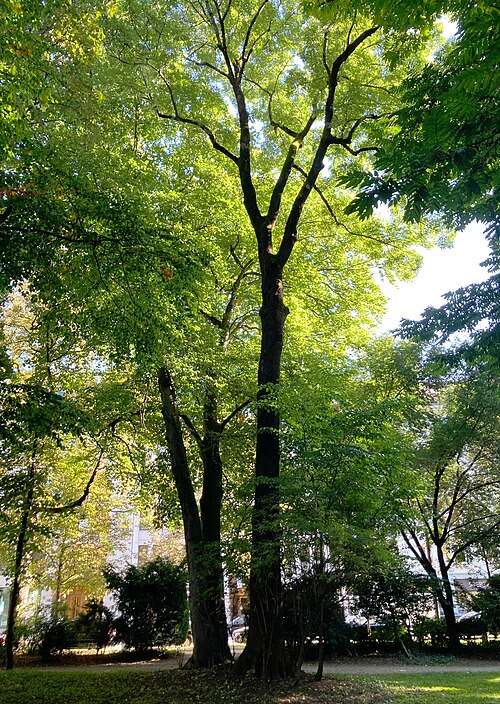
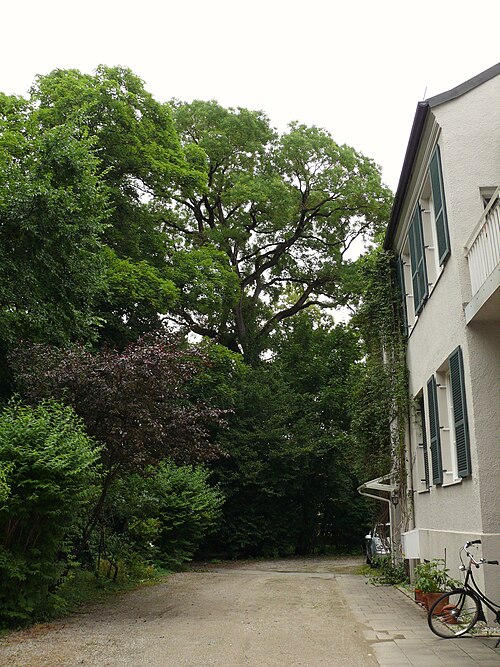
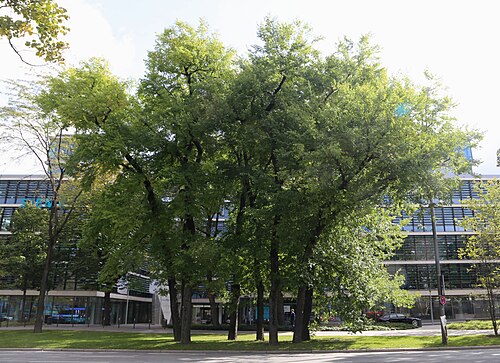
There is an American ash on a square in central Munich, and the city's own ordinance calls the species rare here. Fraxinus americana is the wood a classic baseball bat is turned from, straight-grained, light and good at absorbing shock. In Europe it is a park curiosity rather than a forest tree, which is why Munich's protection order gives as its reason: dominant tree with an interesting growth form, rare in Munich. It stands in the green strip at Maximiliansplatz, in the middle of the city, free to walk up to. Ashes have become a heavier thing to look at over the past two decades. A fungus called ash dieback has been working through Europe's native ash since the 1990s and has killed a large share of it, while the American species is under siege at home from the emerald ash borer, a beetle that has taken tens of millions of trees across North America. A big ash of any species with its crown in good order is no longer an ordinary sight. Its age is simply unknown: the city's list records why a tree is protected and not when it was planted, and no dated source was found. Ash comes into leaf later and drops earlier than most of what surrounds it, so it spends more of the year bare than its neighbours do.
You can recognise it as the American ash on the green strip, a species Munich calls rare here, with a crown that comes into leaf later and drops earlier than its neighbours. It stands on the green strip at Maximiliansplatz.
Sources
Where the facts on this page come from.
- In the official register: Naturdenkmal (Bayern LfU), no. ND-07186
- lfu.bayern.de