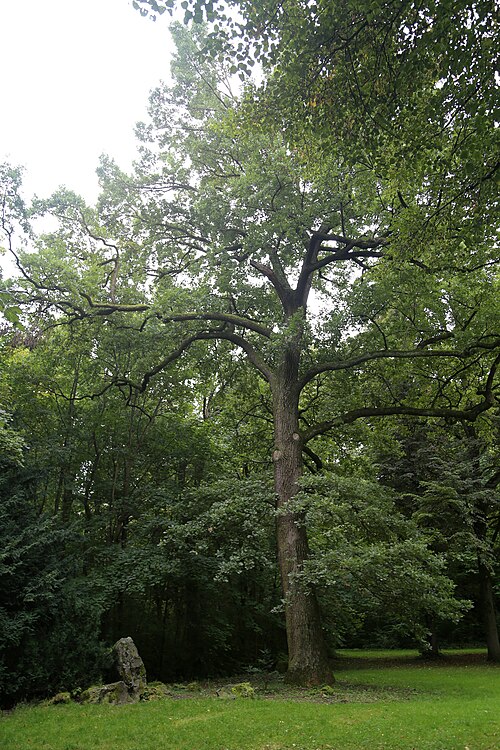
Downy birch is the last broadleaved tree before the tundra. Betula pubescens grows further north than any other, past the Arctic Circle in Scandinavia and across Iceland, and it manages it by staying quick, modest and short lived; a hundred years is a long run for one. Which makes Munich's reason for protecting this one worth reading twice: a mighty solitary tree, rare at this size in the city. It stands in the Flaucher, the belt of gravel banks, pine and poplar along the Isar in the south of Munich where the city comes to swim and grill from May to September. That is the right ground for it. This is the wet-footed birch, the one that takes bogs, fens and river gravel where the silver birch cannot follow, and the fine hairs on its young twigs, the pubescens of the name, are how the two are told apart. Birch bark is white for the same reason a roof is painted white. Betulin, the compound that makes the papery outer layer, reflects sunlight and keeps the trunk from warming and then splitting on cold bright days. It also burns when soaking wet, which is why birch bark has been lighting fires across northern Europe for as long as there have been fires to light. The ordinance gives the reason for protection and no dimensions and no date, and nothing else has measured the tree.
Flaucher, 81379 MünchenYou can recognise it by the fine hairs on its young twigs, which is what separates a downy birch from a silver, and by the white trunk. It stands alone among the pine and poplar on the Isar gravel in the Flaucher.
Free, public land, no restrictions
7 min walk from the Tierpark (Alemannenstraße) bus stop
Sources
Where the facts on this page come from.
- In the official register: Naturdenkmal (Bayern LfU), no. ND-01973
- Munich Naturdenkmalverordnung 2021, Sendling 3
- lfu.bayern.de