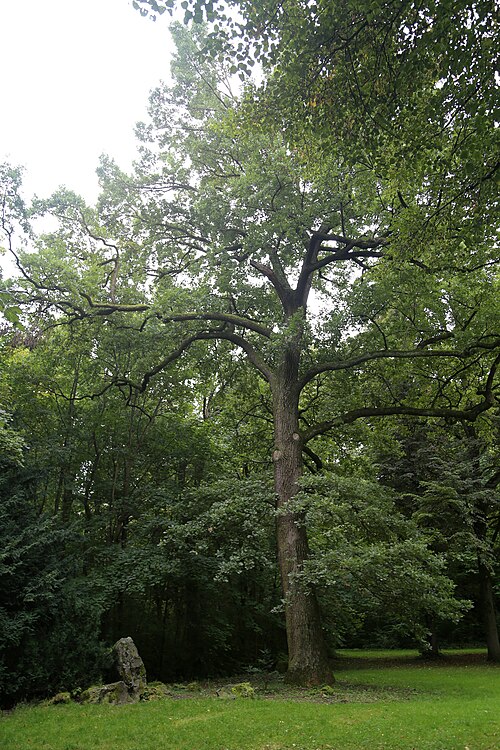
Munich's ordinance calls this one of the mightiest beeches in the city and notes that it carries branches almost to the ground. The second half of that is the part to hold on to. A beech grown in a wood loses its lower limbs to shade and ends up a smooth grey column with all its leaves fifteen metres overhead. A beech grown in the open keeps everything, and the crown comes down in a skirt you have to duck under to reach the trunk. This one has had the room to do it, in the Flaucher, the belt of riverside park along the Isar in the south of the city where Munich goes to swim and grill through the summer. The river beside it is not the one it grew up with. Straightened and walled in the nineteenth century, the stretch through the city was rebuilt between 2000 and 2011, the concrete lifted out and gravel banks let back in, so the beech now stands over a braided river rather than a channel. The city's list gives the reason for protection and no dimensions, so there is no published age or girth. From late October the whole crown turns copper and holds it for weeks, and beech is stubborn about letting go: the young growth keeps its dead leaves all winter.
Autumn colour
late October into November, when a crown this size turns the whole clearing copper
The line is our estimate of how much there is to see, not a measurement. Typical for this species where this tree stands; exact weeks shift with the year.
You can recognise it by the branches, which come almost to the ground in a skirt you have to duck under to reach the trunk. It stands in the Flaucher, the riverside park along the Isar in the south of the city.
Sources
Where the facts on this page come from.
- In the official register: Naturdenkmal (Bayern LfU), no. ND-01971
- stadt.muenchen.de
- lfu.bayern.de