The thickest oak in Hessen stands in the middle of a village that has been gone since 1312. The Hammundeseiche is 8.65 metres round and 25 metres tall, alone in a clearing in the Seulingswald with a rebuilt village well and a small pond beside it. The settlement was deserted three centuries before this acorn landed, which is why the tree grew wide and freestanding instead of drawn up thin in a wood. Free, open forest, about 600 metres on foot from the Nadelohr crossing.
0 of 1 visited in Friedewald
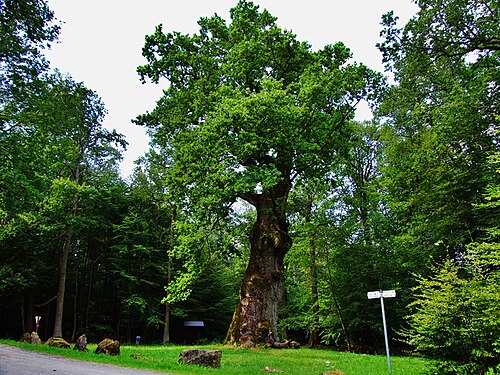
Pedunculate Oak (Quercus robur) · 350-700 years · Seulingswald, the deserted village of Hammundeseiche
The thickest oak in Hessen stands in the middle of a village that has been gone since 1312. Hammundeseiche was a real place, a settlement with a church, first recorded in 1141 and abandoned within two centuries; excavations in 1969 turned up the church foundations, an altar block and graves. What is left above ground is a clearing in the Seulingswald, a reconstructed village well, a small pond, and this oak.
It measures 8.65 metres round at chest height and 8.77 metres a metre up, which makes it the thickest oak in the state and one of the thickest single-stemmed oaks in Germany. It stands 25 metres tall under a crown 20 metres across, on a clear trunk that runs branch-free for a good height and is pocked with holes where limbs tore out.
The dates do not agree, and the disagreement is the interesting part. The published estimate, from two German tree books, is 350 to 440 years. A local expert who has studied old trees for years puts it at 500 to 700: nearly every major limb is hollow, the crown has been retreating for about a century, the bark is deeply furrowed to above ten metres, and at over 400 metres altitude an oak grows slowly. Mercator's map of 1592 already marks a notable tree at this spot. Until about 1905 people called it the oak at the Nadelohr. The name it carries now is the village's.
Photo: Alexander Nowak, via Wikimedia Commons, CC BY 3.0 (CC BY 3.0)