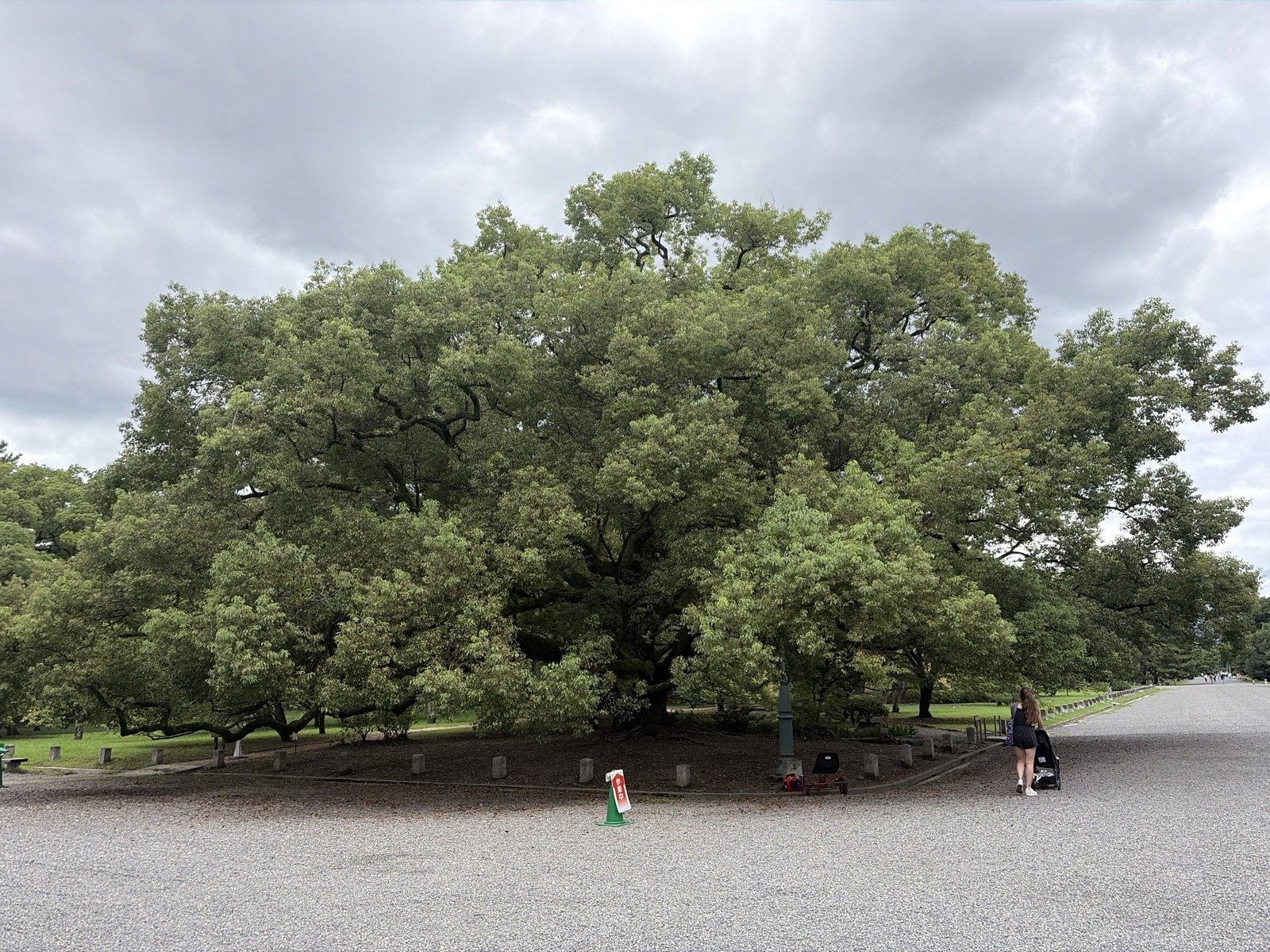
Early cinema ran on this species. Camphor crystals, steam-distilled from the wood and leaves of Cinnamomum camphora, were what made celluloid film stock and photographic plates flexible enough to use, and for decades Japan and its colonies supplied most of the world's camphor, until the chemical industry worked out how to make it from turpentine instead. The trees that fed that trade came down by the forest. This one did not. It grows just inside Shimodachiuri-gomon, a gate in the west wall of Kyoto Gyoen, and Kamigyo Ward lists it among its pride trees at 12.3 metres tall with a trunk 2.76 metres around. Its age appears nowhere. That ward register is the only document naming this tree, and it records dimensions rather than years. Camphors are evergreen, so this is the same tree in February as in July: dense, dark, heavily leaved, and smelling of a medicine cabinet if you crush a leaf between your fingers. It is not the biggest camphor in this park. The one at Munakata Shrine, a short walk away, is far larger and several centuries older, and this is the tree most people go straight past on their way to it. Which is a decent argument for looking up on the way.
The line is our estimate of how much there is to see, not a measurement. Typical for this species where this tree stands; exact weeks shift with the year.
You can recognise it by being the small camphor, 12.3 metres tall on a trunk 2.76 metres round, not the far larger one at Munakata Shrine nearby. It stands just inside Shimodachiuri-gomon in the west wall.
Free. Kyoto Gyoen National Garden is open to the public year-round, dawn to dusk.
Marutamachi Station (Kyoto Municipal Subway Karasuma Line), roughly 5 minute walk
Sources
Where the facts on this page come from.
- In the official register: Kamigyo Ward Proud Trees (上京区民の誇りの木), Kyoto City
- city.kyoto.lg.jp