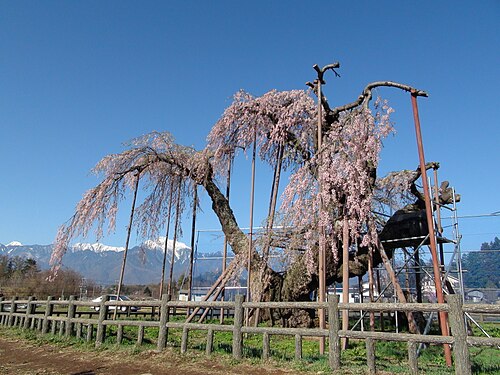
Jindai-zakura (Yamataka Jindai Zakura)
You need a ticket to see this treePaid entry to Jisso-ji Temple grounds during blossom season (approx 500 yen adult, per Japanese-language tourism sources); free rest of year per some listings, so check locally. Grounds are open to the public.
In October 1922 Japan named its first National Natural Monuments. Five single trees were on that list, and this cherry was one of them. It is also counted among the Three Great Cherry Trees of Japan, with Miharu Takizakura in Fukushima and Usuzumi-zakura in Gifu, both designated on the very same day. The age usually given is 1,800 to 2,000 years, tied to a legend that the warrior prince Yamato Takeru planted it. Treat that as a tradition rather than a finding. The prefecture's tourism board, the city of Hokuto and a government cultural publication all repeat the figure and none cites a dating method, and the trunk is too hollow and knotted to read reliably. What can be measured is the base: a root flare given as 11.8 metres round by the prefecture and 13.5 by other listings, under a tree only about 10 metres tall. It grows outward rather than up. It is an Edo-higan, the long-lived species behind many of Japan's oldest cherries, and the blossom is pale and drooping in early April. Bloom forecasters still track this individual tree season by season, which is how we know it is alive and watched. Seeds from it have reportedly been flown into space and grown on around the world. Jisso-ji charges around 500 yen during blossom season. Without a car it is a taxi from Hinoharu or Kobuchizawa.
In bloom
early April, when the pale drooping blossom opens
The line is our estimate of how much there is to see, not a measurement. Typical for this species where this tree stands; exact weeks shift with the year.
Jisso-ji Temple, 2763 Yamataka, Takegawa-cho, Hokuto-shi, Yamanashi 408-0306, JapanYou can recognise it by its huge flared base, nearly 12m round, holding up a tree only about 10m tall that has grown outward rather than upward. It stands on the grounds of Jisso-ji Temple.
Nearest station is JR Chuo Main Line's Hinoharu, then taxi or the Hokuto municipal bus (Mukawa loop line) to the Jindai Koen stop; from Kobuchizawa station it is roughly a 30-minute taxi ride.
Sources
Where the facts on this page come from.