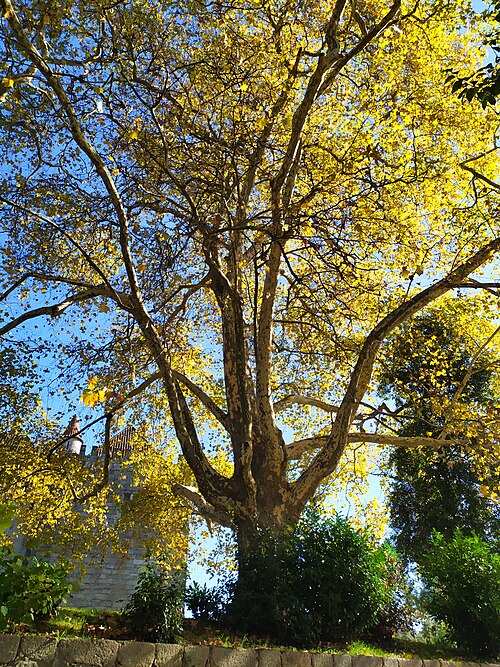
Three Himalayan cedars stand at the gates of Guimaraes' municipal cemetery, tall enough that they read as a landmark from the road below rather than as cemetery planting. Cedrus deodara comes from the western Himalaya, from Afghanistan through to Nepal, where it can live past a thousand years and grow to twice the height these have reached; introduced to European parks in the nineteenth century, it became one of the standard conifers for an avenue meant to impress. One of the three, in the cemetery car park, was measured at 100 years old in 2011 and classified that June, with a trunk four metres seventeen around. Its two companions at the main entrance, girths of 4.10 and 4.47 metres, were added to the classification later and were never separately dated, though their size suggests the same generation rather than a younger planting. A cedar planted at a cemetery gate a century ago was a statement about permanence, evergreen and famously long-lived, standing over a place built for the opposite. It has mostly kept the promise: all three are alive and, unlike the graves around them, still growing.
From people who stood here
No notes yet
Did you visit the tree? Leave a note for the next visitor.
Getting there
Cemiterio Municipal da Atouguia, Creixomil, 4835 Guimaraes
You can recognise it by standing among three tall Himalayan cedars at the gates of the municipal cemetery, visible as a landmark from the road below. It stands in the car park, with two more at the main entrance.
Free, public municipal cemetery, open during daytime visiting hours
About 20-25 min walk from the historic centre, or a short bus ride
Sources
Where the facts on this page come from. The story was written with AI from these sources, and readers who know the tree correct it.
- In the official register: Arvoredo de Interesse Público (ICNF), no. KNJ1/609
- si.icnf.pt
- labpaisagem.pt
- dn.pt