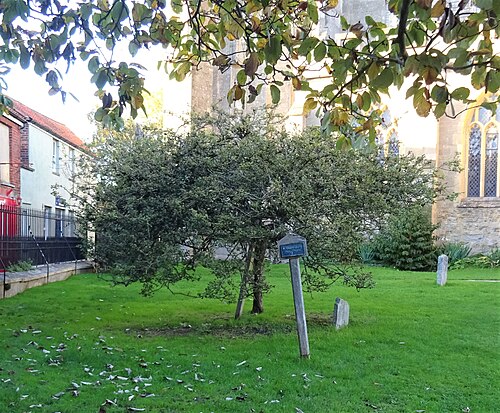
Magog, the Surviving Oak of Gog and Magog
Approximate location.
Seasons1 of 4
Gog is dead, and Magog is hanging on. The two oaks at the foot of Stone Down, east of Glastonbury Tor, are the last of an ancient avenue or grove of oaks that once stood here. In 1906 the rest were felled to make farmland. One of the felled trees was reported at the time to be eleven feet across with more than 2,000 rings, a figure nobody can check now that the wood is gone. The two that were spared carry the names of the legendary giants Gog and Magog, though even the Glastonbury Conservation Society admits nobody is sure which is which. What it can say is that the tree on the right, if you stand with the Tor behind you, still comes into green leaf every spring. Thirty years ago, the Society notes, the other oak looked much the healthier of the two. Now it is dead, its remains scarred by an accidental candle fire in April 2017, and the Woodland Trust's writer called the living one close to the end of her life in 2024. How old Magog is, nobody knows. Popular accounts range from about a thousand years to more than two thousand. No girth has been published and no one has dated the living tree, so we leave the age open. If you have measured it, tell us. The pair stand on farmland at the edge of Wick Farm. They are seen from the lane and footpath beside them.
From people who stood here
No notes yet
Did you visit the tree? Leave a note for the next visitor.
Getting there
Edge of Wick Farm, eastern foot of Glastonbury Tor, near Stone Down Lane, Glastonbury
You can recognise it as the living one of the pair, the oak on the right when you stand with the Tor behind you; its partner is a dead, fire-scarred hulk. They stand at the edge of Wick Farm below Stone Down.
Free to see. The oaks stand at the edge of Wick Farm beside the lane and footpath below Stone Down, at the eastern foot of Glastonbury Tor. They are on farmland, so view them from the path and do not go into the fields.
No railway station in Glastonbury; local bus to the town centre, then roughly 40 to 50 minutes' walk east past the foot of the Tor (about 2.5 km)
In fruit
The line is our estimate of how much there is to see, not a measurement. Typical for this species where this tree stands; exact weeks shift with the year.
Sources
Where the facts on this page come from. The story was written with AI from these sources, and readers who know the tree correct it.