Glastonbury already draws pilgrims for its abbey and its legends, and one more waits in the churchyard of St John the Baptist. The Glastonbury Thorn is a hawthorn that flowers twice a year, once with everything else in spring and once around midwinter, when nothing else in England is doing much of anything. Every specimen descends from grafted cuttings tied to a legend of Joseph of Arimathea. Since 1929 a flowering sprig has been cut each December and sent to the reigning monarch, a tradition this particular tree still keeps.
0 of 1 visited in Glastonbury
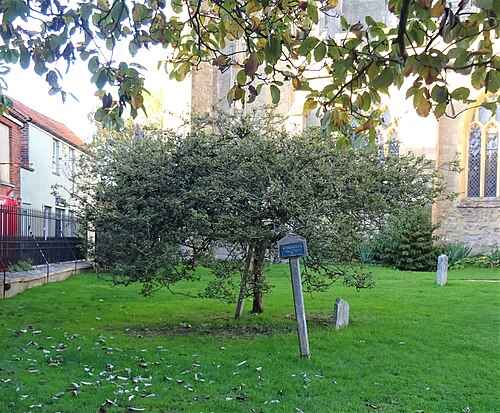
Hawthorn (Crataegus monogyna 'Biflora') · 90 years · Glastonbury town centre
Every December, children from St John's Infants School cut a flowering sprig from this hawthorn and send it to the reigning monarch. They have done it since 1929. The tree can oblige because it is Crataegus monogyna 'Biflora', a hawthorn that flowers twice a year, once in spring like every other one and once around midwinter, when nothing else in the churchyard is doing anything at all. The trait does not survive seed, so every Holy Thorn in Glastonbury is a cutting grafted from the last one.
This specimen was planted in the 1930s by George Chislett, then head gardener at Glastonbury Abbey, who learned to graft Holy Thorn cuttings onto blackthorn rootstock. That makes it about ninety years old, and it is the one that lasted. The Abbey's tree died in 1991 and was cut down the following year. The tree on Wearyall Hill was attacked in December 2010, lost its replacement sapling in 2012, and was taken out altogether in 2019.
By tradition the whole lineage descends from a staff pushed into the ground by Joseph of Arimathea, a story first written down in 1520, and a Parliamentary soldier is said to have felled the original around 1647. Recent decades have been harder on it than any legend. In 2018 it was described as decrepit and heavily infested with mistletoe. A visit in December 2024 found it almost clear of the stuff and flowering well.
Photo: Rosser1954 (CC BY-SA 4.0)