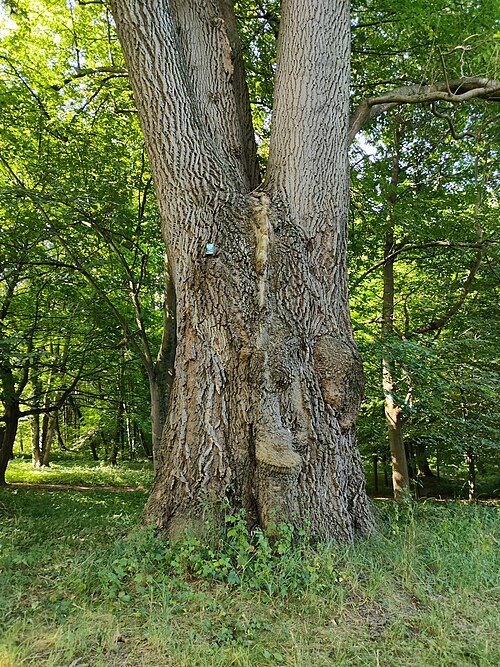
In 1685 the estate around this oak became the property of Jan III Sobieski, the king who had broken the Ottoman siege of Vienna two years earlier. The story attached to the tree is about his wife. Marysienka is said to have rested under it, and in the grotto a little further on, which looks out over the sea. That is a legend and the sources say so. What is on record is drier and nearly as good: the oak went into the Gdynia register of natural monuments on 28 June 1966, one of the first entries, and it is the oldest protected tree in the city. Girth 4.87 metres, height 26. It used to be a twin. Two trunks had fused into one and in 1988 they came apart. The broken half is still lying near the base, and the surviving trunk has been propped and reinforced ever since, which is what you see first: pale timber struts running up under the lower limbs like scaffolding somebody forgot to take down. The estimates run from 350 to 400 years and nobody has counted the rings, so the tree either predates Sobieski's purchase or arrived shortly after it. Both would make the legend possible, which is presumably why it has lasted.
In fruit
September to October: acorns drop, and a good mast year buries the ground in them
The line is our estimate of how much there is to see, not a measurement. Typical for this species where this tree stands; exact weeks shift with the year.
Park Kolibki, in the wooded upper part of the manor grounds, Gdynia OrlowoPale wooden props leaning in under the lower limbs, a heavy single trunk where two used to be fused, and the broken half of the tree still lying on the ground beside it.
Free. The Kolibki manor park is public, open in daylight, and the oak stands in the wooded upper part.
SKM train to Gdynia Orlowo, about 35 minutes from Gdansk Glowny and 12 from Gdansk Oliwa, then roughly ten minutes on foot to the park.
Sources
Where the facts on this page come from.
- In the official register: Centralny Rejestr Form Ochrony Przyrody (GDOŚ)
- crfop.gdos.gov.pl
- krajoznawcy.info.pl