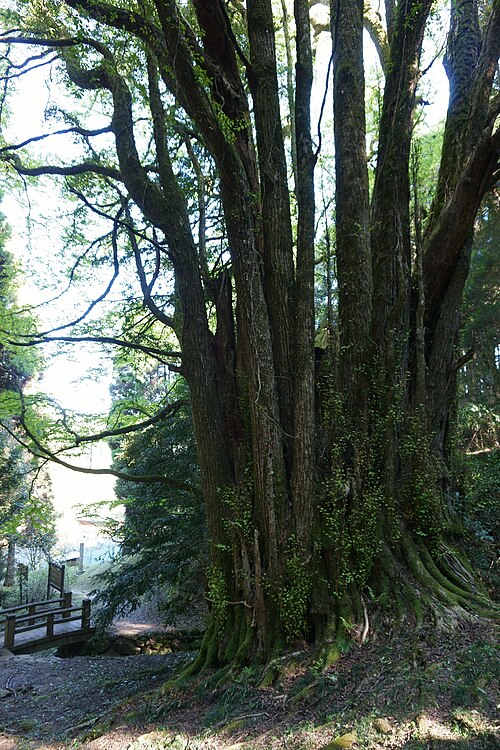
The Great Yamamomo of Kanatake
An owl sometimes nests in the hollow of this tree's trunk, which Fukuoka's own ward government mentions on its page about the specimen without treating it as remarkable, just one more fact about a tree old enough to have grown a cavity worth nesting in. Estimated at three to four hundred years old, it is the larger of only two Myrica rubra the prefecture has designated a natural monument, its root spread alone measuring eight metres across. Red bayberry is more commonly a large shrub than a proper tree, grown across East Asia for a tart, dark red summer fruit that stains fingers and pavement alike; reaching four metres round at chest height and standing fourteen metres tall, this one has outgrown the category by any measure. The ward's own page and an independent survey of Japan's giant trees disagree on the exact girth by thirty centimetres, a gap almost certainly explained by different measurement dates rather than a mistake either way. The tree stands on private land whose owner has kept it open to the public, and the same page that welcomes visitors also asks them to tread carefully: foot traffic compacting the soil over its roots is named as a real threat to its health, not a formality. No train station sits within walking distance; a bus from Meinohama, Hashimoto or central Fukuoka runs to the Kanatake stop nearby.
Kanatake, Nishi Ward, Fukuoka (postal area 819-0035)You can recognise it by its thick trunk, 4.4 metres round and 14 metres tall, with a root spread 8 metres across and a hollow sometimes used by a nesting owl. It stands in Kanatake, Nishi Ward.
Privately owned but open to the public (the ward government's own page says so explicitly); visitors are asked to be careful, since foot traffic compacting the soil over the roots is named as a real risk to the tree's vigour, not a formality.
No train station is within walking distance (Hashimoto or Jiromaru stations are both roughly 2.7km, about 33-34 minutes on foot). Nishitetsu Bus routes 1 or 2 run to the 'Kanatake' stop from Meinohama Station's south exit, Hashimoto Station, Hakata Station bus terminal or Tenjin; the tree stands in the neighbourhood around that stop.
Sources
Where the facts on this page come from.