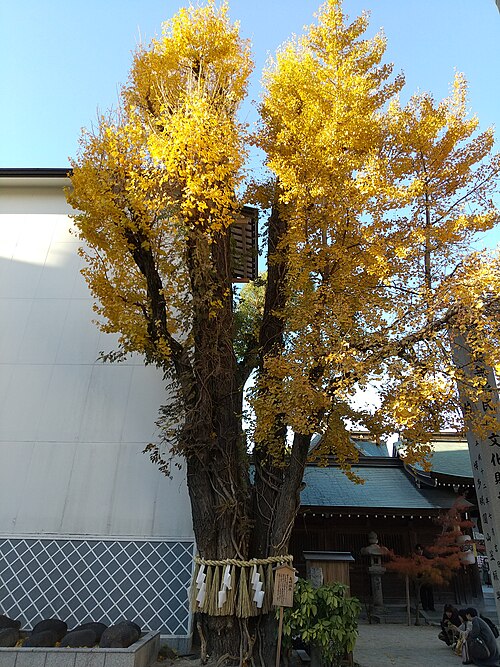
The Married Camphor and Great Ginkgo of Torikai Hachimangu
Despite the name, the Married Camphor is one tree, not two. Its trunk forks into a pair from a single base low to the ground, which is exactly why visitors to Torikai Hachimangu read it as a couple rather than a single specimen, and why a shrine built around relationships adopted it as a symbol for exactly that. Cords get tied to its shimenawa rope by people hoping their own pairing holds as well as the tree's two trunks have. Twelve metres away, flanking the shrine's torii from the other side, stands the Great Ginkgo, called locally the Ibuki Ginkgo. The shrine's own account puts its age at five to six hundred years, a figure with no independent source found to confirm it, so treat it as tradition rather than a documented fact, the same caution this page applies to a wartime survival story attached to the tree elsewhere online, which nothing beyond the shrine's own telling supports. Both trees stand in the open shrine forecourt, free to visit at any hour a Shinto shrine keeps its grounds open, reachable on foot from either Tojinmachi or Nishijin subway station. Camphor on the left of the torii, ginkgo on the right, both close enough to touch from the same few steps.
The line is our estimate of how much there is to see, not a measurement. Typical for this species where this tree stands; exact weeks shift with the year.
Torikai Hachimangu, 2-1-17 Imagawa, Chuo Ward, FukuokaYou can recognise the camphor by its trunk forking into two from a single base near the ground, cords tied to its shimenawa rope. It flanks one side of the torii at Torikai Hachimangu, the ginkgo 12 metres away.
Free. Both trees stand in the open approach/precinct of Torikai Hachimangu, a public Shinto shrine, immediately flanking the torii; no gate or restriction beyond ordinary shrine visiting hours.
Fukuoka City Subway Airport Line: Tojinmachi Station, about 6 minutes on foot, or Nishijin Station, about 7 minutes. Also reachable by Nishitetsu bus to the Jigyo or Imagawa-nishimachi-koen-mae stops, a couple of minutes' walk.
Sources
Where the facts on this page come from.