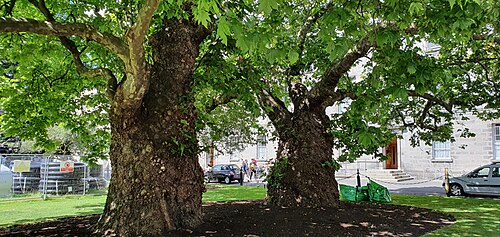
Lord Ardilaun planted a windbreak in the 1870s that is still doing its job a century and a half later. Sixty seven holm oaks, evergreen and Mediterranean, line the main avenue and old estate boundaries of St Anne's Park, chosen because Dublin Bay's cold easterly winds off Bull Island would otherwise strip anything deciduous bare for half the year. Arthur Guinness, first Baron Ardilaun, inherited the estate in 1868 and spent much of his fortune turning it into a private demesne with formal gardens and grand tree-lined approaches, only for Dublin Corporation to buy the whole estate from his family in 1939 and open it to everyone. The oaks never got the memo that they were meant to shelter a private house: they shelter dog walkers, parkrunners and a Saturday market instead. Unlike most street trees, a holm oak keeps its dark, leathery leaves through the Irish winter, so the avenue looks essentially the same in January as it does in July, a rare piece of consistency in a park that changes with every season around it.
From people who stood here
No notes yet
Did you visit the tree? Leave a note for the next visitor.
Getting there
Main Avenue, St Anne's Park, Raheny, Dublin 5
You can recognise it by the long row of dark, evergreen holm oaks lining the avenue, unchanged through winter and summer alike. It stands along the Main Avenue of St Anne's Park, Raheny.
Free, public park, open at all hours
DART to Raheny or Harmonstown station, then a short walk
Sources
Where the facts on this page come from. The story was written with AI from these sources, and readers who know the tree correct it.