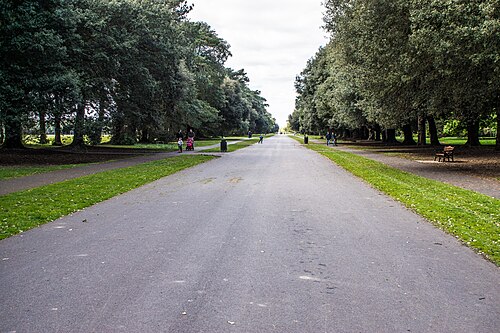
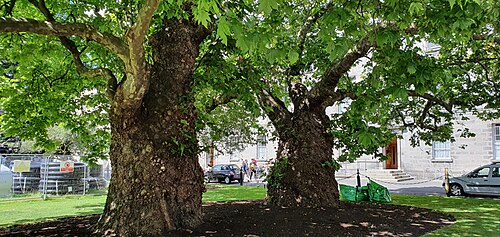
Most of St Anne's Park's holm oaks do exactly what Lord Ardilaun planted them to do: stand in a straight, uniform line and block the wind coming off Dublin Bay. This one refused to cooperate. A 2009 field survey for the Heritage Trees of Ireland project singled it out from the surrounding avenue as a genuine arboricultural curiosity, a holm oak that grew several trunks from a single base instead of the clean single stem its neighbours all share, most likely the result of being cut back hard while young and responding by throwing up multiple new leaders rather than one. Evergreen and Mediterranean, like the rest of the avenue Ardilaun planted from the 1870s onward to shelter his estate from the coast's easterly winds, it has had a full century or more for its odd shape to settle into something closer to sculpture than accident, gnarled and dense where its neighbours are straight and orderly. It stands near the park's northeast corner, not far from the carved cypress trunk that draws most of the attention in this part of the grounds. Unlike that piece of dead wood turned into art, this one is still doing what a tree does every spring: pushing out new leaves from several trunks instead of one.
From people who stood here
No notes yet
Did you visit the tree? Leave a note for the next visitor.
Getting there
St Anne's Park, near the coast road, Raheny, Dublin 5
You can recognise it by its several trunks rising from one base, unlike the single-stemmed holm oaks lining the avenue beside it. It stands near the coast road in St Anne's Park, Raheny.
Free, public park, open at all hours
DART to Raheny or Harmonstown station, then a short walk
Sources
Where the facts on this page come from. The story was written with AI from these sources, and readers who know the tree correct it.
- In the official register: Heritage Trees of Ireland (Tree Council of Ireland / National Biodiversity Data Centre, Dataset 27), no. 450
- gbif.org
- en.wikipedia.org