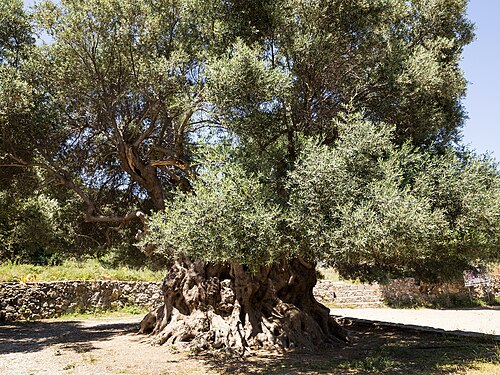
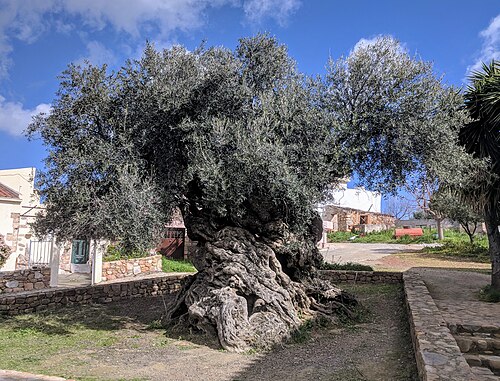
The trunk measures roughly 24 metres around, which is among the largest recorded for a plane tree in Europe. Local practice turns that number straight into an age: each metre of perimeter is said to stand for a century, so the village puts the tree at 2,400 years. That is arithmetic performed on a tape measure rather than evidence about the tree, and it is worth saying why the sum is unsafe here in particular. Oriental planes regenerate from the root. A stool this size can be many centuries of renewal rather than one stem that has lived continuously since antiquity, so a vast perimeter is not the same thing as a vast age. Nobody has dated this one. If you know of a study that has, tell us. What the tree unarguably is: the centre of Krasi, a village 600 metres up on the road from Malia toward the Lasithi plateau. It grows in the Megali Vrisi square beside a stone fountain that still runs all year, and the tavernas put their tables under the canopy, so the square works as a room with a roof rather than a monument behind a rope. Sources report it as a proclaimed monument of nature; the declaring instrument itself was not traced. In a Cretan July, the shade is the whole argument.
The line is our estimate of how much there is to see, not a measurement. Typical for this species where this tree stands; exact weeks shift with the year.
Megali Vrisi square, Krasi, Hersonissos municipality, Heraklion regional unit, Crete, GreeceIn the village square beside the stone fountain that runs all year, roughly 24 metres round, with the taverna tables set out under the canopy.
Free. It stands in the open village square at Krasi, about 600 m above sea level, beside the stone fountain that still runs all year. Tavernas sit under the canopy, so the square is in daily use rather than fenced off.
Krasi is roughly 12 km inland from Malia on the Heraklion coast, up the road towards the Lasithi plateau. A car is the realistic way; the tree is in the village square and cannot be missed.
Sources
Where the facts on this page come from.