Crete's four trees are 190 kilometres apart at the extremes, so this is a driving list rather than a walk. Two are ancient olives at opposite ends of the island, at Ano Vouves near Chania in the west and at Kavousi in Lasithi in the east, and both are dated in thousands of years by methods that argue with each other. The other two are plane trees, one filling a mountain village square at Krasi, one keeping its leaves all winter at Gortyn.
0 of 4 visited in Crete
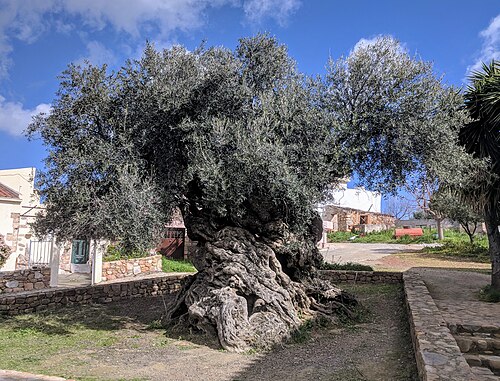
Olive (Olea europaea) · 2000-4000 years · Ano Vouves village, next to the Olive Tree Museum of Vouves
Two sets of scientists have dated this olive and their answers differ by two thousand years. Ring analysis by Oliver Rackham and Jennifer Moody, published in 1996, established a floor and no more: at least 2,000 years old. Scientists at the University of Crete have since put it at 4,000, a figure now repeated from the Greek press to Forbes, and one that would make it the oldest living olive known anywhere. Neither number can be checked. The tree's heartwood rotted away centuries ago, which is what happens to ancient olives rather than a fault in this one, and it removes the material any dating method needs. English Wikipedia's summary is blunt: the exact age cannot be determined, and there is no agreed scientific method for dating olive trees at all.
The trunk is not in dispute. It measures 12.5 metres around and 4.6 metres across, hollowed into a twisting shell with the grain running in curves. The tree still fruits, grafted with the Tsounati cultivar, and the Region of Crete declared it a protected natural monument in 1997. Branches from it were woven into victory wreaths at the Athens Olympics in 2004 and Beijing in 2008. Two Geometric-period cemeteries were found nearby, which tells you people were here three thousand years ago and nothing whatsoever about the tree.
Photo: Eric Nagle (CC BY-SA 4.0)
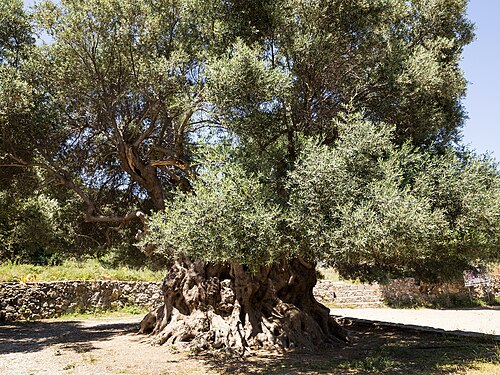
Olive (Olea europaea) · 3,000-3,400 years · Azoria, near Kavousi
Somebody grafted this tree in the Bronze Age and it is still carrying the join. The crown you look at is a mouratoelia, a local eating cultivar, growing on a wild olive rootstock underneath, and Greek and international sources describe it as the oldest known example of olive grafting anywhere in the world. That claim is repeated everywhere and traced to no single paper, so take it as the consensus rather than a citation.
The age is firmer than that, and firmer than Crete's more famous olive in the west. Ring analysis reported by the municipality of Ierapetra dates the planting to between 1350 and 1100 BCE, putting the tree somewhere around 3,000 to 3,400 years old, and the press has settled on about 3,250. One method, one range, and the sources agree with each other, which is not something the olive at Vouves can offer.
It stands about a kilometre south of Kavousi on the road toward Avgos, beside the excavated settlement of Azoria that gives it its name, signposted from the eastern entrance of the village as the old olive. The trunk runs 14.2 metres around and 4.9 metres across. It still bears fruit. Branches from it made the winner's wreath for the women's marathon at the Athens Olympics in 2004, and Greece has declared it a protected monument of nature.
Photo: Unukorno (CC BY 4.0)
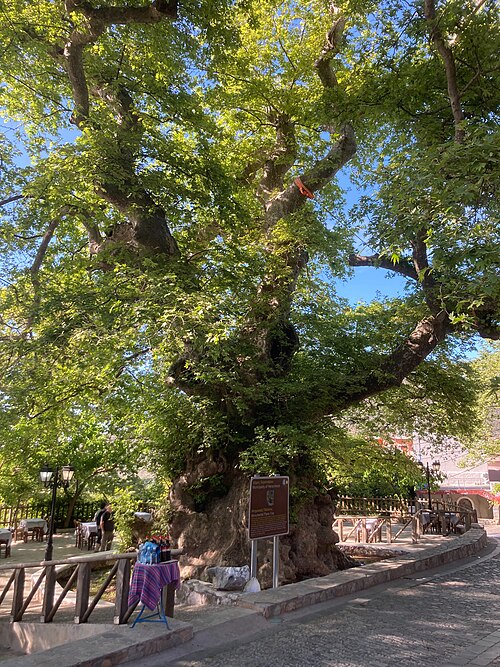
Oriental Plane (Platanus orientalis) · the village square, beside the stone spring-fountain
The trunk measures roughly 24 metres around, which is among the largest recorded for a plane tree in Europe. Local practice turns that number straight into an age: each metre of perimeter is said to stand for a century, so the village puts the tree at 2,400 years. That is arithmetic performed on a tape measure rather than evidence about the tree, and it is worth saying why the sum is unsafe here in particular. Oriental planes regenerate from the root. A stool this size can be many centuries of renewal rather than one stem that has lived continuously since antiquity, so a vast perimeter is not the same thing as a vast age. Nobody has dated this one. If you know of a study that has, tell us.
What the tree unarguably is: the centre of Krasi, a village 600 metres up on the road from Malia toward the Lasithi plateau. It grows in the Megali Vrisi square beside a stone fountain that still runs all year, and the tavernas put their tables under the canopy, so the square works as a room with a roof rather than a monument behind a rope. Sources report it as a proclaimed monument of nature; the declaring instrument itself was not traced. In a Cretan July, the shade is the whole argument.
Oriental Plane (Platanus orientalis) · at the back of the archaeological site, near the Odeon and the Law Code
Every other oriental plane on Crete is bare in January. This one is not. The tree at Gortyn is Platanus orientalis var. cretica, an evergreen form of a deciduous species, reported from perhaps fifty places on the island and from almost nowhere else, and it holds its leaves straight through the winter. That is the reason to walk to the back of the archaeological site, and it is a better reason than the one the guidebooks give.
The guidebook reason is Europa. Gortyn is where Zeus, in the shape of a bull, is said to have carried her, and their union under a plane tree is stamped on the city's own ancient coins. That story belongs to the place and not to this trunk, and nothing connects the two. Read the coins as evidence of how long people here have associated the site with a plane tree, which is genuinely interesting, and not as a birth certificate for the one growing there now.
Nobody has dated it, and there is a botanical reason why nobody easily could. Planes regenerate from the root, so what looks eternal can be a succession of new stems on an old base, and the sources describing this one note that in its present form it is relatively small. It is protected, it is evergreen, and its age is an open question. If you know more, tell us.