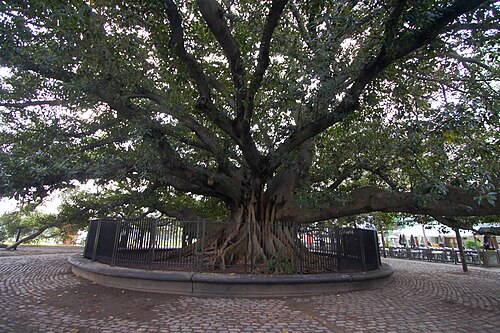
Most old trees carry an estimated age. This one carries a date. On 11 November 1875 President Nicolas Avellaneda put a magnolia into the ground with his own hands to inaugurate Parque Tres de Febrero, and the tree he planted is still standing where he left it. The arithmetic is therefore unusually honest: 151 years this November, with no growth rate and no guesswork in it. A plaque placed in 1916 quotes the line from his inaugural speech that the choice of tree came from, la magnolia americana del bosque primitivo, con su flor blanca silvestre, the American magnolia of the primeval forest with its wild white flower. In June 1946 a national decree made it an Arbol Historico, putting it on the short list of trees the Argentine state protects for what happened around them rather than for their measurements. Since then the park has closed in and become the Bosques de Palermo, the green lung the whole neighbourhood is named for. The Jardin Japones went up alongside, so the tree that opened the park now stands against a garden wall on Avenida Berro, passed by joggers who have no idea it is the reason any of this is here. Come in the southern spring, when the heavy white flowers open. That is roughly the same few weeks each year as the anniversary of the day it went in.
In fruitIn bloom
October and November, when the big white flowers open, close to the anniversary of its planting
The line is our estimate of how much there is to see, not a measurement. Typical for this species where this tree stands; exact weeks shift with the year.
Av. Adolfo Berro 241, near Av. Casares, beside the Jardin Japones, Parque Tres de Febrero (Palermo Woods)A single magnolia against the wall of the Jardin Japones on Avenida Berro, inside Parque Tres de Febrero.
Free, standing in the open public parkland of Parque Tres de Febrero (Palermo Woods), open daily
About 10-15 minutes' walk from Plaza Italia (Subte Line D) through the park, or several bus lines along Av. Sarmiento/Av. Figueroa Alcorta
Sources
Where the facts on this page come from.