Buenos Aires's oldest trees do not share a park. A fig by the Recoleta Cemetery gate that the city calls its oldest, a pair of magnolias flanking a school built over the Viceroyalty's first medical tribunal, another magnolia planted by a president's own hand in 1875, and a tropical outsider with no age at all, one of only two of its kind in the city. Four stops in four different neighbourhoods, each worth crossing town for on its own, none of them close enough to combine into a single walk.
0 of 4 visited in Buenos Aires
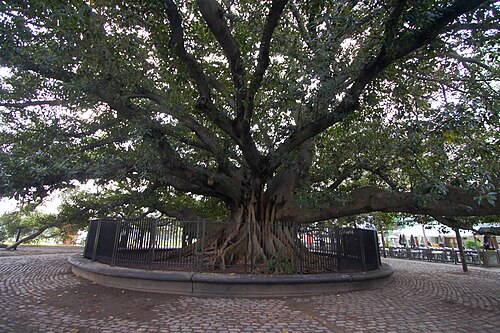
Moreton Bay Fig (Ficus macrophylla) · 250-300 years · Recoleta
One branch of this fig reaches thirty metres out from the trunk and is over a metre thick where it leaves it. Since 2014 a sculpture of Atlas, welded from car parts by the Uruguayan artist Joaquin Arbiza Brianza, has stood underneath it appearing to take the weight. The city government calls this the oldest tree in Buenos Aires, and nobody agrees on how it got here. One account has the Recoleto friars planting it around 1718. Another credits the agronomist Martin Jose de Altolaguirre, who kept an orchard of exotic species on this ground around 1781. Either version puts it here before Argentina was a country, a few metres from the gate of the Recoleta cemetery, watching two centuries of the city arrive to bury its dead.
The species is disputed as well. Porteños call it a gomero, a loose word attached to several big figs in Argentina. The city's own register describes Ficus macrophylla, the Moreton Bay fig, and its account of the leaves and fruit fits that; Wikidata files the same tree as Ficus elastica, the rubber tree. We have gone with the register and flagged the disagreement rather than settling it.
The measurements need reading carefully too. The seven metres quoted across its trunk is the buttressed, fused mass a strangler fig builds over time, not a single round stem, so the girth figure here is far larger than any ordinary waistline.
Photo: Anastasiya Lvova (CC BY 3.0)
Southern Magnolia (Magnolia grandiflora) · 200 years · San Telmo
These two magnolias are the oldest living thing on the block where Buenos Aires first taught medicine. They flank the entrance of a primary school built over the site of the Protomedicato, the Viceroyalty's medical tribunal founded by Miguel O'Gorman, which also held the city's first Hospital de Hombres and its first school of medicine. Argentina declared the pair Historic Trees by national decree in August 1969, and the city has looked after them since.
How old they are is an open argument, and the city's own register runs both ways on a single page. Its text says the Bethlemite order planted them at the end of the 19th century, which would make them around 140. The same page, and every other source that mentions them, says more than 200 years and ties them to the Bethlemites' 18th-century work on this ground. The likeliest reading is a slip between XVIII and XIX, so we carry the older claim with the doubt attached rather than picking a winner.
You look at these two rather than walk up to them. The school is in daily use and its grounds are closed to visitors, so the place to stand is Humberto Primo itself, or the doorway of the San Pedro Gonzalez Telmo church opposite, which is where the photographs get taken from. It is half a block from Plaza Dorrego, so the detour costs nothing.
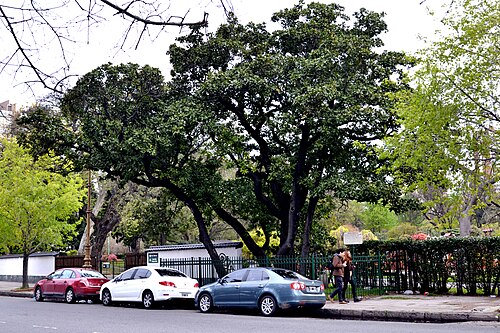
Southern Magnolia (Magnolia grandiflora) · 150 years · Palermo
Most old trees carry an estimated age. This one carries a date. On 11 November 1875 President Nicolas Avellaneda put a magnolia into the ground with his own hands to inaugurate Parque Tres de Febrero, and the tree he planted is still standing where he left it. The arithmetic is therefore unusually honest: 151 years this November, with no growth rate and no guesswork in it.
A plaque placed in 1916 quotes the line from his inaugural speech that the choice of tree came from, la magnolia americana del bosque primitivo, con su flor blanca silvestre, the American magnolia of the primeval forest with its wild white flower. In June 1946 a national decree made it an Arbol Historico, putting it on the short list of trees the Argentine state protects for what happened around them rather than for their measurements.
Since then the park has closed in and become the Bosques de Palermo, the green lung the whole neighbourhood is named for. The Jardin Japones went up alongside, so the tree that opened the park now stands against a garden wall on Avenida Berro, passed by joggers who have no idea it is the reason any of this is here.
Come in the southern spring, when the heavy white flowers open. That is roughly the same few weeks each year as the anniversary of the day it went in.
Photo: Carlos Zito (CC BY-SA 3.0)
Scarlet Sterculia (Sterculia coccinea) · San Nicolas (Tribunales)
Two trees of this species are known in the whole of Buenos Aires, and this is the one with an address. Sterculia coccinea is a tropical species from Southeast Asia, and the city's register lists it among the notable trees of Buenos Aires on rarity alone rather than for size or age: about eight metres tall, heavily branched, with a crown that spreads wider than the tree stands high. Its flowers come yellow green flushed with red in spring, and later in the year the capsules split open to show a bright red lining.
The address is the point as much as the tree is. Plaza Lavalle sits between the Teatro Colon and the Palacio de Justicia, so this quiet tropical outsider has spent its life between the country's opera house and its supreme court, with the crowds that both of those attract passing underneath it.
Nobody has dated it. No register, plaque or article we could find gives an age or a trunk measurement, and an empty field is better than an invented number. If you know when it went in, tell us and we will put it on the page.
The pin marks the plaza rather than the trunk, so give yourself a minute to pick it out from the trees around it: look for the wide, low, many-branched crown near the Cordoba and Talcahuano corner.