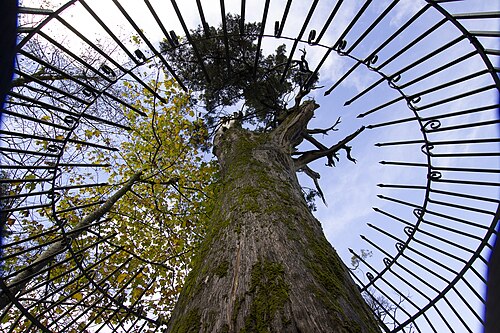
The Pedunculate Oak of the Capela de Sao Pedro
Almost everything classified in this forest arrived by ship. This oak did not. Quercus robur is one of only two native species on Bucaco's whole list of protected trees, a remnant of the woodland that stood here before the Carmelites arrived in the 1620s and began filling the hillside with cypresses, redwoods and eucalyptus from four continents. Wikipedia's account of the forest names a stand of oak among the survivors of that original cover, which is exactly what this is: not an import chosen for a garden, but a native species that grew here before the friars built the convent and its wayside chapels. This one stands by the chapel of Sao Pedro on the Via Sacra, four metres ninety around the trunk and twenty-four metres tall, with a crown that reaches almost twenty-one metres across, comfortably the widest native canopy in the collection. The state's 2016 measurement put it at three hundred years, tied with the cypress at the first Via Sacra station for the second oldest tree in the register after the Cedro de Sao Jose, though no source beyond the register dates this individual tree. It is easy to walk past it looking for the exotic specimen and miss the one tree here that was never planted for effect.
In fruit
August to September: acorns drop, and a good mast year buries the ground in them
The line is our estimate of how much there is to see, not a measurement. Typical for this species where this tree stands; exact weeks shift with the year.
Capela de Sao Pedro, Via Sacra, Mata Nacional do Bucaco, 3050-261 LusoYou can recognise it as one of only two native species in the whole collection, its crown almost 21 metres wide, the widest native canopy here. It stands by the Capela de Sao Pedro.
Free on foot. Cars pay 5 euros at the forest gate
On the Via Sacra path above the monastery, about 600 m up from the Largo do Mosteiro
Sources
Where the facts on this page come from.
- In the official register: Arvoredo de Interesse Público (ICNF), no. AIP01110411I
- si.icnf.pt
- en.wikipedia.org
- fmb.pt