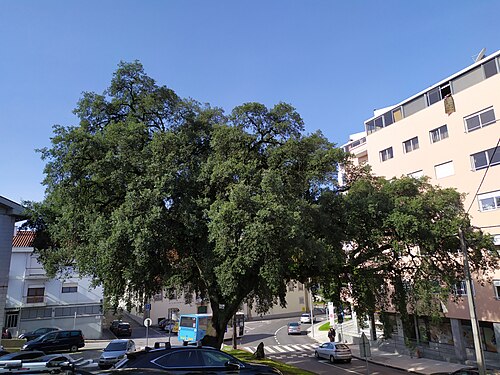
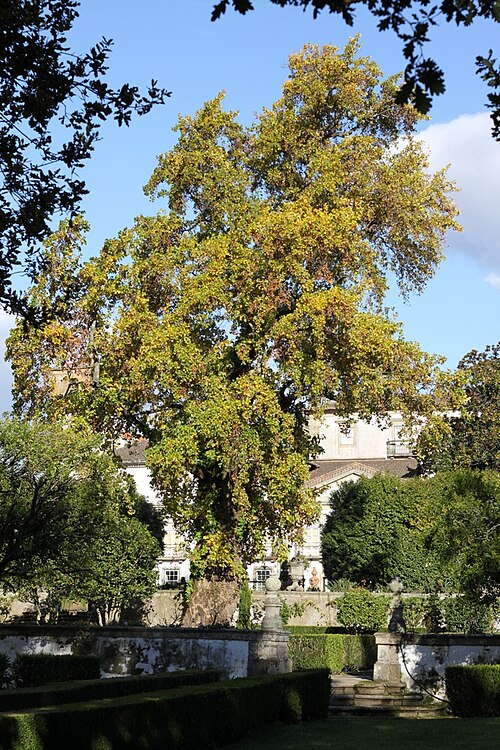
Three oaks, one entry. Portugal's register of trees of public interest classifies these as a conjunto arboreo, a single grouped listing, and gives one set of figures for all three: 2.7 metres round, 16.7 metres tall, and 85 years old when they were measured in 2011, so around a century now. It does not say which of the three the tape went round, or whether the number is an average. They stand in the same square as the cork oak, sixty metres off, and were protected in the same act, celebrated at the same ceremony on World Forest Day in March 2012. The local paper covering it described the oaks as one of the main attractions of Largo de Santa Tecla, valued for shade in summer and for the space underneath them, which the neighbourhood uses as its own. Quercus robur is the common oak of northern Europe, and northern Portugal is near the warm edge of where it grows well. The name comes from the acorns: they hang on long stalks, peduncles, while the leaves sit almost directly on the twig, which is the reverse of the arrangement on a sessile oak and the quickest way to tell the two apart in autumn.
In fruit
August to September: acorns drop, and a good mast year buries the ground in them
The line is our estimate of how much there is to see, not a measurement. Typical for this species where this tree stands; exact weeks shift with the year.
Largo de Santa Tecla, Calcada de Santa Tecla, BragaThe group of three deciduous oaks in the square, standing together about sixty metres from the single cork oak with the thick corky bark.
Free. Same public square as the Cork Oak of Santa Tecla, open at all times.
About 1.5km from central Braga; a 20-25 minute walk, or a short bus/taxi ride.
Sources
Where the facts on this page come from.
- In the official register: ICNF, Arvoredo de Interesse Publico
- ICNF, Arvoredo de Interesse Publico (Portugal's national register of trees of public interest) (processo KNJ3/073)
- correiodominho.pt