Braga's oldest tree is North American: a tulip tree of about 285 years in the baroque garden of the Palacio dos Biscainhos, now the city museum, and one of ten finalists for Portugal's Tree of the Year in 2026. Out at Santa Tecla, a cork oak and a group of three oaks share one square and were protected in the same act in 2012. At the foot of the Bom Jesus funicular, an oak and a plane both carry the same official name, the tree of the embrace.
0 of 4 visited in Braga
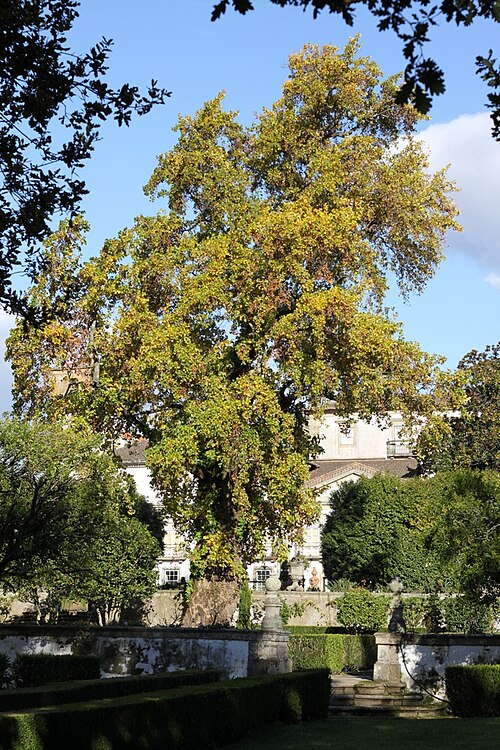
Tulip Tree (Liriodendron tulipifera) · 285 years · UF Braga (Maximinos, Se e Cividade)
Portugal shortlisted this tree for its Tree of the Year in 2026, one of ten finalists nationally. It is a tulip tree, Liriodendron tulipifera, native to the eastern United States, and the coverage of that shortlist calls it the largest of its kind in the country.
The measurements depend on who took them. Portugal's register of trees of public interest recorded 6.5 metres round the trunk, 27.4 metres tall and a crown of 18 metres when it classified the tree in 2010. The 2026 reporting gives 30 metres and 19. Both are plausible for a tree that has kept growing, and neither is picked here as the winner.
Age is firmer. The register put it at 270 years at that 2010 measurement, which makes it roughly 285 now, and the newspaper coverage places the planting in the reign of Joao V, who died in 1750. It went into the baroque garden of the Palacio dos Biscainhos, a hectare of formal beds, orchard and kitchen garden behind a Braga townhouse that is now the city's museum.
It was planted as one of a symmetrical pair. The other tulip tree lasted until the late 1970s; a replacement went in nearby in 1997 and is still an obviously young tree. The gap between the two is the clearest thing on the site for understanding what 285 years actually does.
Photo: Adelino Manuel Pinhe… (CC BY-SA 3.0)
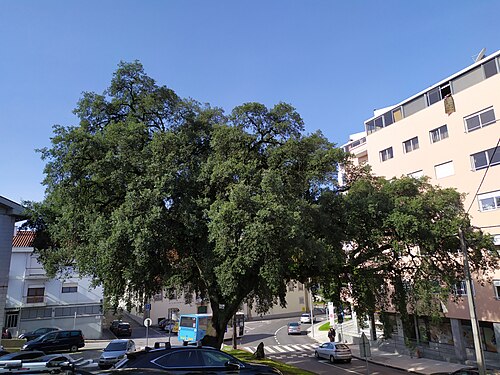
Cork Oak (Quercus suber) · 165 years · Braga (Sao Vitor)
The parish spent about six years asking before this cork oak was protected. When the classification came through they marked it on 21 March 2012, World Forest Day, with fourth-year pupils from the primary school up the road, who were handed the job of guarding it.
The national register gives the trunk 3.5 metres round, the tree 15 metres tall, and the crown 21 metres across, which is wider than the tree is high. That shape is the point of it. Largo de Santa Tecla is a square people actually use, and what a crown like that produces on a Minho summer afternoon is shade. The register dated the tree to 150 years at the 2011 measurement, so about 165 now.
Quercus suber is the tree the cork industry is built on, and Portugal produces more cork than any other country. The bark is the reason: thick, spongy, fire-resistant, and it grows back after stripping, which almost no other tree manages. A cork oak standing in a public square is generally left unharvested and keeps that bark, deeply furrowed and pale, a surface that looks several sizes too big for the trunk underneath.
Three oaks classified in the same act stand about sixty metres away, so the whole stop takes a minute.
Pedunculate Oak (Quercus robur) · 85-115 years · Braga (Sao Vitor)
Three oaks, one entry. Portugal's register of trees of public interest classifies these as a conjunto arboreo, a single grouped listing, and gives one set of figures for all three: 2.7 metres round, 16.7 metres tall, and 85 years old when they were measured in 2011, so around a century now. It does not say which of the three the tape went round, or whether the number is an average.
They stand in the same square as the cork oak, sixty metres off, and were protected in the same act, celebrated at the same ceremony on World Forest Day in March 2012. The local paper covering it described the oaks as one of the main attractions of Largo de Santa Tecla, valued for shade in summer and for the space underneath them, which the neighbourhood uses as its own.
Quercus robur is the common oak of northern Europe, and northern Portugal is near the warm edge of where it grows well. The name comes from the acorns: they hang on long stalks, peduncles, while the leaves sit almost directly on the twig, which is the reverse of the arrangement on a sessile oak and the quickest way to tell the two apart in autumn.
Pedunculate Oak and London Plane (Quercus robur, Platanus x acerifolia) · 90-120 years · UF Nogueiro e Tenoes
An oak and a plane standing twenty metres apart at the foot of the Bom Jesus funicular are registered under the same name: arvore do Abraco, the tree of the embrace. That is not a nickname picked up from a guidebook. It is written into each tree's own entry in Portugal's register of trees of public interest, and both were classified on the same day in July 2010.
What nobody has written down is why. No source we have found explains the name: whether the two crowns once met over the path, whether it belongs to a story attached to the sanctuary on the hill above, or whether it is simply what people in Tenoes have always called them. If you know where the name comes from, tell us and it goes on the page.
Both trees were put at 100 years old when they were measured in 2010, which makes them around 115 now. The oak is the heavier of the two, 3.7 metres round with a crown almost 25 metres across; the plane is slimmer at 2.55 metres and marginally the taller at 26.
They stand at the station of the Elevador do Bom Jesus, the water-counterbalanced funicular that has hauled pilgrims up to the sanctuary since 1882. Looking at the trees costs nothing. The ride is a separate ticket.