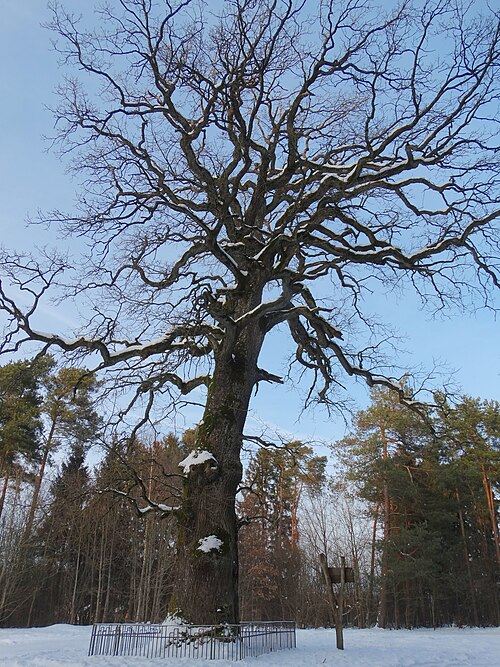
Three Academy Awards trace back to the bog at the end of this trail. Hermann Sudermann, the German-language writer the oak is named for, stayed often in the village of Zalgiriai and watched the peat-cutters at work here, then wrote their lives into his novella Die Reise nach Tilsit. F.W. Murnau filmed it in 1927 as Sunrise: A Song of Two Humans, which took three awards at the first Academy Awards ceremony. The tree stands at the far end of the roughly two kilometre trail through that former peat-cutters' colony, and it is the reason for the walk rather than a stop along the way. It is also the only natural monument in the whole of Nemunas Delta Regional Park. Three trunks rise from one base, 4.62 metres round between them and 17.6 metres tall. Lithuania placed it under state protection in 2005. Sudermann died in 1928, a year after the film. The colony he wrote about is gone and the cutting has stopped, and the trail now runs through what those workers left behind. The oak is the last thing on it. Nobody has dated this one. The recorded girth is a combined figure for three trunks rather than a single stem, which makes the usual growth-rate arithmetic unreliable, so the age stays an open question. If you know it, tell us.
From people who stood here
No notes yet
Did you visit the tree? Leave a note for the next visitor.
Getting there
End of the Zalgiriai educational nature trail (Zalgiriu pazintinis takas), Zalgiriai forest (compartment 15, section 23), on the Silute-Rusne road, within Nemunas Delta Regional Park, Silute district
You can recognise it by its three trunks rising from one base, 4.62 metres round combined and 17.6 metres tall, at the far end of a 2 km trail. It stands in Zalgiriai forest, the only natural monument in Nemunas Delta park.
Free, public nature trail inside Nemunas Delta Regional Park; the tree stands at the far end of the marked, roughly 2 km Zalgiriai educational trail through a former peat-cutters' colony. No ticket, no restriction.
By car via the Silute-Rusne road to the Zalgiriai trail car park, then on foot along the marked educational trail (about 2 km) to the tree at its end. No direct public transport to the trailhead found.
In fruit
September to October: acorns drop, and a good mast year buries the ground in them
The line is our estimate of how much there is to see, not a measurement. Typical for this species where this tree stands; exact weeks shift with the year.
Sources
Where the facts on this page come from. The story was written with AI from these sources, and readers who know the tree correct it.