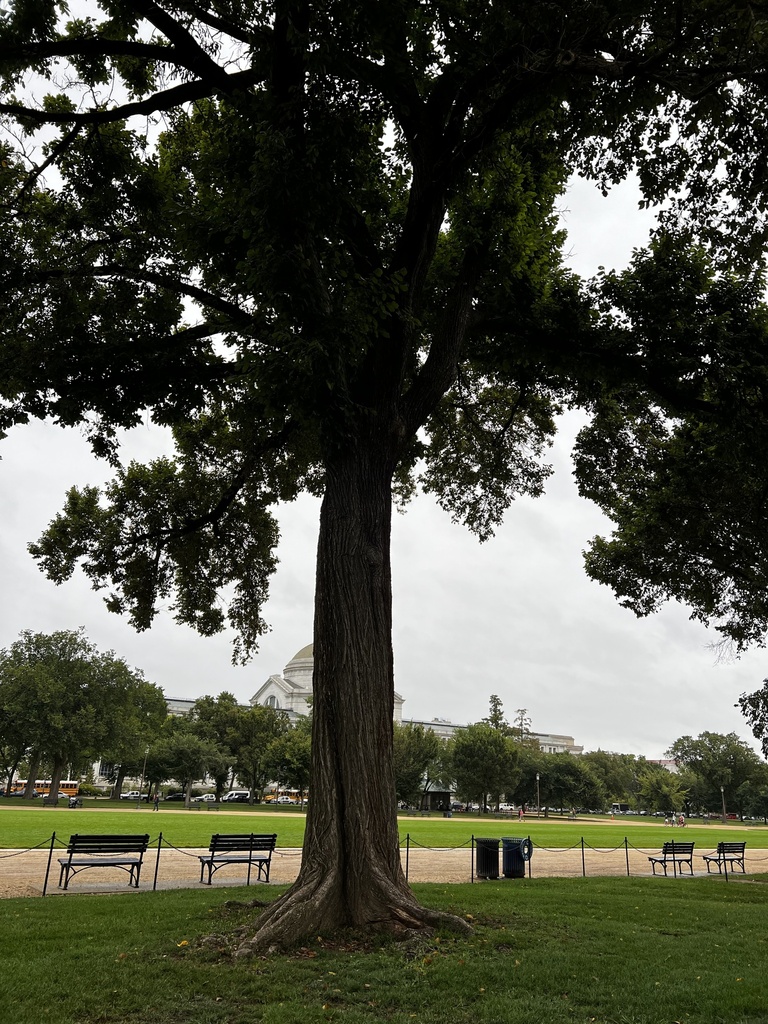
The Smithsonian Witness Elm
National Mallthe National Mall
Seasons0 of 4
The Smithsonian catalogues this tree the way it catalogues everything else. It is accession number 1 in the Smithsonian Gardens Tree Collection, the first of roughly 1,900 living specimens held as museum objects, and it stood on this corner long before the museum behind it opened in 1910. The measurements are why it holds that number. Five and a half metres round, about twenty six metres up, and a crown thirty five metres across, on a species that the century after its planting nearly wiped out. Dutch elm disease reached Washington in 1950 and took most of the American elms on the Mall over the following forty years. This one kept going, and the Smithsonian's gardeners call it the Witness Elm for everything that has passed it on its way between the White House and the Capitol. Its age is an open question, and the two answers come from different kinds of evidence. The sign at its foot and the Smithsonian's own magazine both say planted around 1850. Smithsonian Gardens, which owns it, calls it more than two hundred years old, which would have it here before the British burned the city in 1814. A planting record and a growth estimate disagree by half a century and we have not resolved it, so the page gives both.
From people who stood here
No notes yet
Did you visit the tree? Leave a note for the next visitor.
Getting there
National Museum of Natural History grounds, north end of the Butterfly Habitat Garden, 9th Street and Constitution Avenue NW, Washington, DC
You can recognise it by the size: a trunk five and a half metres round under a crown thirty five metres wide, far bigger than anything near it. It stands at the 9th Street corner of the Butterfly Habitat Garden.
Free, fully public. Stands in the Butterfly Habitat Garden along Constitution Avenue, open ground beside the museum, no ticket and no gate.
About 8 min walk from Federal Triangle or Archives Metro; the museum's Constitution Avenue side, at the 9th Street corner.
The line is our estimate of how much there is to see, not a measurement. Typical for this species where this tree stands; exact weeks shift with the year.
Sources
Where the facts on this page come from. The story was written with AI from these sources, and readers who know the tree correct it.