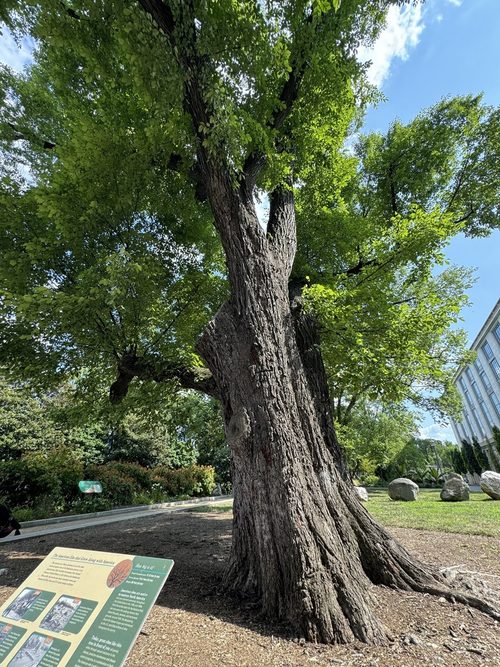
When Union Square was rebuilt in the 1930s, five Caucasian elms survived the clearance. Four were dug up and transplanted. This one was left exactly where it grew, which is why it matters more than the other four. It has stood on this spot since around 1850, when the United States Botanic Garden moved its greenhouse collections here, some of them gathered on the Wilkes Expedition of 1838 to 1842. Zelkova carpinifolia comes from the mountains of the Caucasus and northern Iran and is still an uncommon tree in American planting. This one is almost certainly among the largest in the country, though it will never appear in the national register of champion trees, which tracks native species only. The Park Service survey calls it the most historically significant tree remaining in Union Square, because it is the one that combines all three things: planted in the Botanic Garden's own period, never moved, and genuinely rare. Its position saved it twice. Sitting at the far southwest edge, well outside the central vista Frederick Law Olmsted Jr. was carving, it escaped the 1930s clearance that took 250 trees, then escaped again in 1971 when the Capitol Reflecting Pool went in and destroyed most of what remained. The Architect of the Capitol puts it at 150 to 175 years. The Grant Memorial bur oak, from the same original planting, stands about 350 metres away across the same square.
From people who stood here
No notes yet
Did you visit the tree? Leave a note for the next visitor.
Getting there
Union Square, U.S. Capitol Grounds, southwest grass panel, Washington, DC
You can recognise it as the one Caucasian elm left ungrown when its four companions were transplanted elsewhere. It stands in Union Square's southwest grass panel, about 350 metres from the Grant Memorial oak.
Free, fully public. Stands on open U.S. Capitol Grounds parkland (Union Square), unrestricted viewing, about 350m from the Grant Memorial Bur Oak in the same square.
Same as the Grant Memorial Bur Oak: roughly 10-15 min walk from Capitol South or Union Station Metro.
Autumn colour
September to October: the whole crown turns orange-brown, the tree's best-known moment after its shape
The line is our estimate of how much there is to see, not a measurement. Typical for this species where this tree stands; exact weeks shift with the year.
Sources
Where the facts on this page come from. The story was written with AI from these sources, and readers who know the tree correct it.