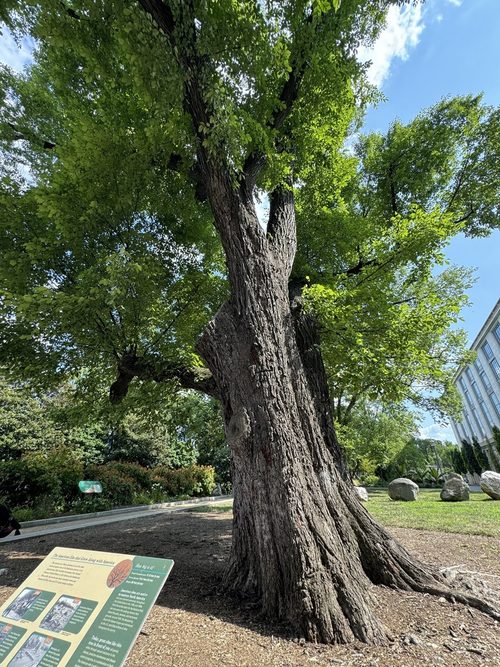
The National Mall Jefferson Elm
National Mallthe National Mall
Approximate location.
Seasons0 of 4
Every 'Jefferson' elm planted in the United States is a cutting taken from this tree. It went into the ground around 1935, one of roughly 600 American elms set in four rows to frame the Mall's central green, and by rights it should have died with the rest. Dutch elm disease reached the Mall in 1950 and had killed more than 200 of that planting by 1994. In the early 1990s the Park Service pathologist Horace Wester noticed that tree number 3-487 leafed out earlier than its neighbours and held its leaves longer. A decade of testing by the Park Service, the National Arboretum and Michigan State confirmed genuine resistance to the disease. DNA work then found something stranger. The tree is triploid, carrying 42 chromosomes where an American elm carries 56, which appears to explain both the resistance and the strong U shaped branch unions that keep it from splitting in storms. In February 2005 cuttings went out to commercial nurseries as the 'Jefferson' cultivar, named for the drive it stands beside. It is neither the oldest nor the biggest tree in this city, and it may be the most consequential, because American elms are going back into streets across the country on the strength of its genetics. The survey that recorded it placed it across Jefferson Drive from the Freer Gallery without giving a coordinate, so this pin is close rather than exact.
From people who stood here
No notes yet
Did you visit the tree? Leave a note for the next visitor.
Getting there
National Mall, across Jefferson Drive SW from the Freer Gallery of Art (National Museum of Asian Art), near 12th St SW, Washington, DC
You can recognise it as an American elm that leafs out earlier and holds its leaves longer than its neighbours in the row. It stands on the National Mall, across Jefferson Drive from the Freer Gallery.
On the National Mall; about 10 min walk from Smithsonian Metro station (Blue/Orange/Silver).
The line is our estimate of how much there is to see, not a measurement. Typical for this species where this tree stands; exact weeks shift with the year.
Sources
Where the facts on this page come from. The story was written with AI from these sources, and readers who know the tree correct it.