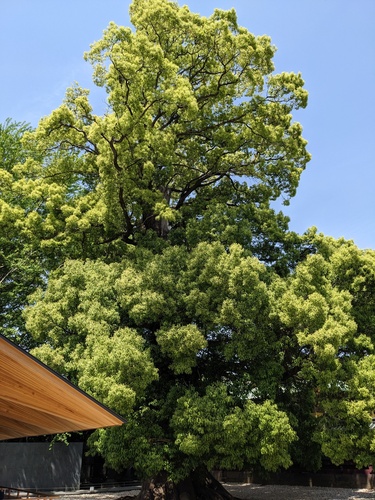
This ginkgo used to be a national treasure and technically is not one anymore, and the reason why says everything about it. Legend holds that a branch stuck in the ground here by the shogun Minamoto no Yoritomo, visiting around 1189, took root and grew into this tree, which would make it roughly 800 years old. The Japanese government designated it a Natural Monument in 1930. Then, on the night of March 10, 1945, American firebombs burned nearly all of Asakusa to the ground, including Sensoji's main hall and its five-story pagoda, both later rebuilt from scratch. The ginkgo was hit directly. Its trunk is still hollow and blackened five or six meters up, a permanent scorch mark from a night that killed roughly 100,000 people in Tokyo. The fire damage was severe enough that the monument designation was revoked after the war. The tree itself was not deterred: it kept growing, and it is the one part of Sensoji that watched the temple burn and rebuild around it rather than the other way around.
From people who stood here
No notes yet
Did you visit the tree? Leave a note for the next visitor.
Getting there
Sensoji, 2-3-1 Asakusa, Taito-ku, Tokyo 111-0032
You can recognise it by the trunk, still hollow and blackened five or six metres up where the firebombs of March 1945 caught it. It stands in the grounds of Sensoji in Asakusa.
5 min walk from Asakusa Station (Ginza/Asakusa/Tobu lines)
Autumn colour
late November, when the leaves turn gold
The line is our estimate of how much there is to see, not a measurement. Typical for this species where this tree stands; exact weeks shift with the year.
Sources
Where the facts on this page come from. The story was written with AI from these sources, and readers who know the tree correct it.