The Himalayan Cedar of Yanaka
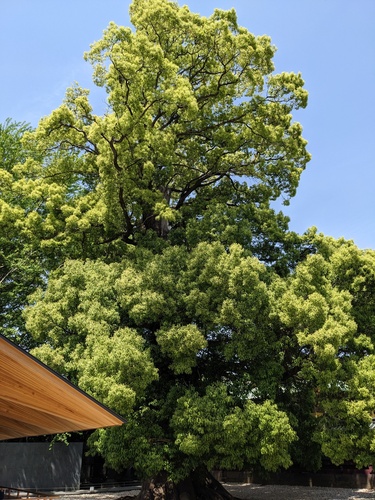
This tree started as a pot plant. Around 1926 the grandfather of the Mikado bread shop, at whose door it still stands, kept a Himalayan cedar seedling in a container and watered it with the water left over from rinsing rice, until it outgrew the pot and went into the ground at the corner. It is now twenty metres tall and four metres round, and it fills a small triangular street junction in Yanaka entirely. Nothing about it belongs here. Cedrus deodara comes from the western Himalaya, and a hundred-year-old one wedged into a lane of low wooden houses in old Tokyo is worth going to look at once. Taito ward gave it formal protection in 2006, and the junction sits on the national list of a hundred historic Japanese landscapes. Its age is argued over by about a decade. The ward's own page says ninety years; Tokyo Shimbun ran a headline in October 2019 calling it a hundred, and a survey the following spring recorded the same. That October typhoon tore off roughly a third of the crown and shut the road for days. The ward cut back what was left in November 2020, pruned again after that, and by September 2024 the tree had been braced against the next storm. A century on, the pot is a footnote and the cedar is the landmark. It is on open street, with no gate and no hours.
The line is our estimate of how much there is to see, not a measurement. Typical for this species where this tree stands; exact weeks shift with the year.
Yanaka 1-6-15, Taito-ku, TokyoYou can recognise it by the size, twenty metres tall and four metres round, filling a small triangular junction of low wooden houses. It stands on the open street at the door of the old Mikado bread shop in Yanaka.
Free, no gate at all: the tree stands on public land at a small triangular street junction in Yanaka, beside what was a bakery, and is visible and reachable at any hour.
Nippori Station (JR Yamanote Line / Keisei Line), roughly a 10 minute walk through the Yanaka Ginza area
Sources
Where the facts on this page come from.