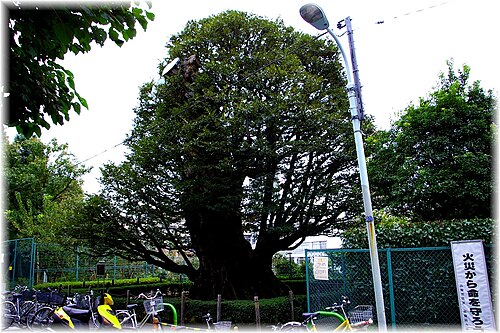
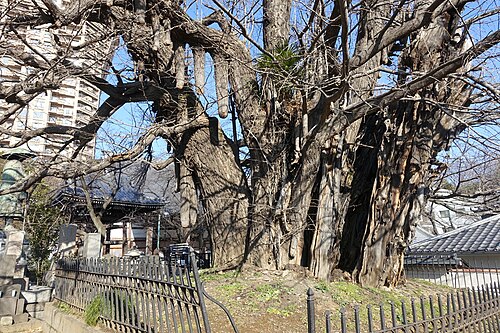
Tokyo once designated a set of black pines as its own Natural Monuments. This is the last of them left standing. The metropolitan survey literature records it as the only survivor of that group as of 2015, and as the second-largest pine in Tokyo after the great one at Zenyoji in Edogawa. It grows beside the Umazaka slope in Denenchofu, on ground that belonged to Shozenji, a Jodo-shu temple founded in 1639. The trunk climbs straight for about seven metres and then opens out into an umbrella, which is what a black pine does when nothing crowds it: roughly seventeen metres tall, about four metres round, and around three hundred years old, which is as precise as any source is willing to be. At its foot is a small stone shrine to Akiba, the temple's guardian deity, and that is where the tree gets its name. Three centuries beside a road is hard work. A city survey in 1986 found it vigorous, with limbs reaching out over a neighbouring building; those were cut back for wind risk, and more came off after snow broke what remained. It was photographed on a temple walk in September 2025, still fanning out over the slope. The city designated it on 19 March 1963. There is no gate and no ticket: the pine stands on the public path up the hill, where it has been the whole time.
Denenchofu 5-chome 3-19, Ota-ku, Tokyo, beside the Umazaka slope east of Shozenji TempleYou can recognise it by the trunk, straight for about seven metres before it opens into an umbrella, seventeen metres tall and four round. It stands beside the Umazaka slope east of Shozenji, a small stone shrine to Akiba at its foot.
Free. Stands beside the public road up the Umazaka slope on the east side of Shozenji Temple, on land that historically belonged to the temple; visible and reachable directly from the street, no gate to pass.
Denenchofu Station (Tokyu Toyoko Line / Meguro Line), roughly 10-20 minute walk uphill
Sources
Where the facts on this page come from.