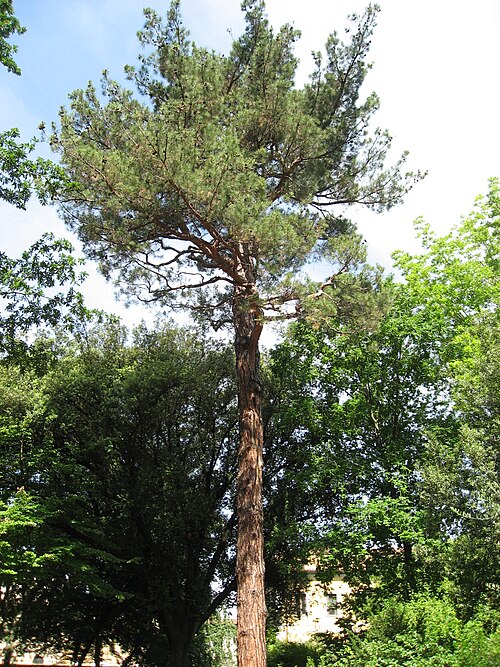
The garden keeps this pine under constant watch, and says so in print, because its crown has grown into a flag.
Photo: Line1 (CC BY-SA 3.0)
Pinus brutia
Pinus brutia goes by three different names depending on where you stand in front of it: Turkish pine in English, pino bruzio or pin de Calabre on the ground in Italy and France, pino de Creta in Spain, describing a pine from Turkey, Cyprus, Crete and the Levant that colonises burnt ground first and produces a honey beekeepers actively seek. We map 3 of them, in 3 cities.
Botanists still argue whether it deserves its own species or belongs folded into the Aleppo pine; the national register in Florence files its specimen under Pinus halepensis regardless. Three cities map one each, and each shows a different way an old pine stands: Florence's has grown a lopsided, storm-prone flag crown after a century squeezed into a crowded botanical collection, Rouen's needed a support structure built under it in 2021, and Valencia's went straight up for thirty metres without leaning, forking or flattening at all.
The garden keeps this pine under constant watch, and says so in print, because its crown has grown into a flag.
Photo: Line1 (CC BY-SA 3.0)
Beekeepers know this species better than gardeners do.
In June 2021 the city of Rouen put a pine tree on crutches.
Explore by city: Florence · Valencia · Prague · Brussels · Porto · Seville · Munich · Brisbane · every city · or browse all species.