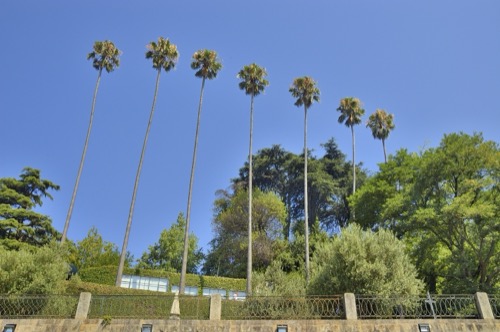
The building these palms were planted for was demolished in 1951.
Photo: Paulo V. Araujo, Dias com Arvores
Washingtonia robusta
The building these palms were planted for was demolished in 1951 and the palms are still standing: seven Mexican fan palms in a line at the Palacio de Cristal in Porto, roughly 160 years old, outliving the glass hall they were meant to frame. We map 5 of them, in 4 cities.
That is the pattern with this species in Europe, which arrives as instant architecture and then outlasts it. Granada's four went up over the Plaza de Gracia in 1923, the year the palace behind them was finished. Palermo's line an avenue in the Villa Giulia, which opened in 1778 and is generally counted as Italy's first public garden. Valencia has two from the early twentieth century, one of them the result of a gardener's error that left it standing where it should not have been, taller and thinner than every palm around it.
The building these palms were planted for was demolished in 1951.
Photo: Paulo V. Araujo, Dias com Arvores
Four Mexican fan palms tower over Plaza de Gracia, planted in 1923 the year construction finished on the Palacio de los Yanguas, the building bordering the square behind a garden wall on Calle Gracia.
A gardener's mistake left this palm standing taller and thinner than every other one around it.
This palm survived being in the way twice, first of traffic and then of a demolition crew, thanks to one head gardener's refusal to let it simply be cut down.
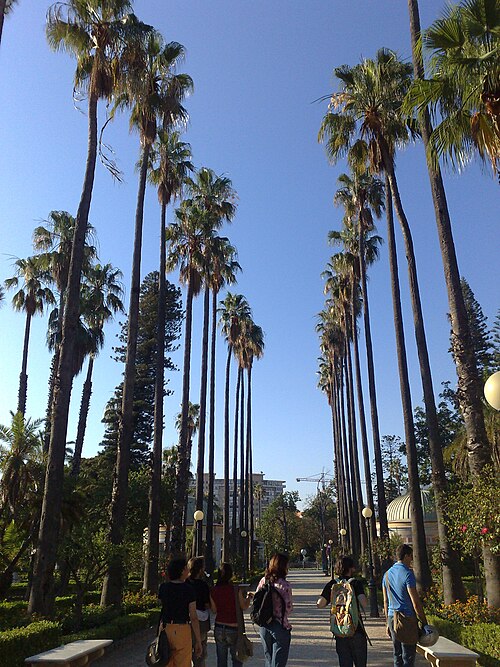
Villa Giulia opened in 1778, which makes it, by most accounts, Italy's first public garden, decades before Rome, Florence or Milan opened anything comparable to ordinary citizens rather than nobility.
Photo: Dedda71 (CC BY 3.0)
Explore by city: Porto · Granada · Valencia · Palermo · Prague · Brussels · Brisbane · Munich · every city · or browse all species.