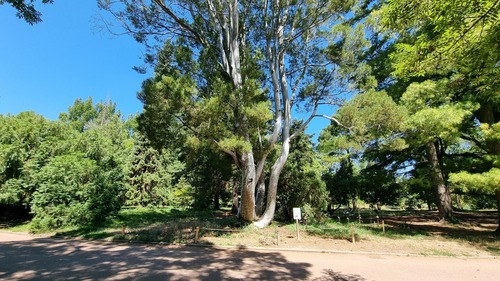
This pine's bark peels in patches of grey, green and cream as it ages, a trait so distinctive that the species barely needs its Latin name to identify it.
Photo: Julien Lepage (CC BY)
Pinus bungeana
Most pines are planted for their needles or their shape. We map 3 of them, in 3 cities.
This one is planted for its bark, which sheds in irregular plates of olive, grey-green and chalk white until an old trunk looks close to ivory, a trait so distinctive the species barely needs its Latin name to identify it. Pinus bungeana is native to China, and every specimen mapped here arrived somewhere else as a deliberate transplant. Lyon's, in the Parc de la Tête d'Or arboretum, was probably planted in 1856 and is known locally as the Pin de Napoléon. Pittsburgh's stands in Mellon Park, named to the city's own official Remarkable Trees list in 2023 for its bark alone, with no age on record. Seoul's, beside the Constitutional Court in Jae-dong, carries a six-century legend that a Ming dynasty envoy brought it as a gift, unproven but attached to the tree for generations. Three cities so far.
This pine's bark peels in patches of grey, green and cream as it ages, a trait so distinctive that the species barely needs its Latin name to identify it.
Photo: Julien Lepage (CC BY)
This pine is not native to Korea.
Most pines wear dark, furrowed, forgettable bark.
Explore by city: Lyon · Seoul · Pittsburgh · Prague · Brussels · Seville · Munich · Porto · every city · or browse all species.