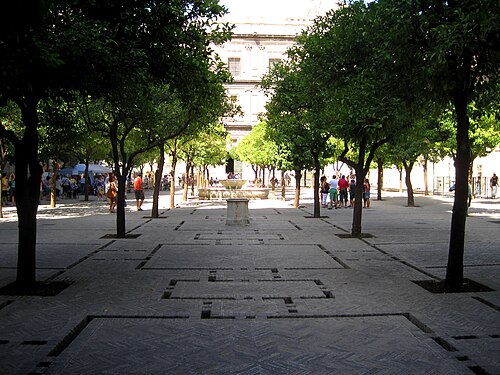
The orange trees that give Seville Cathedral's most famous courtyard its name aren't nearly as old as the courtyard itself.
Photo: Roberto Chamoso G (CC BY-SA 3.0 ES)
Citrus aurantium
Citrus aurantium is too sour to eat off the tree, which is exactly why it survived where sweeter oranges would have been picked bare: it was planted for shade, symmetry and scent rather than fruit. We map 3 of them, in 2 cities.
Its home in this data is the ablutions courtyards of Andalusia's great mosques, later absorbed whole into the cathedrals built over them. Cordoba's Patio de los Naranjos is the grove that gives the type its name here, ninety-eight trees in rows lined up with the prayer hall's columns, watered by channels that trace back to a tenth-century cistern; oranges are recorded growing in it since at least 1512, replanted tree by tree ever since, so the grid is ancient and no single trunk is. Seville Cathedral's own Patio de los Naranjos looks the same age but is not: a twentieth-century restoration replanted it, whatever grew there before did not survive. And in the Real Alcázar a single stunted bitter orange carries the name of Pedro the Cruel with no record of when it was planted or why, which the page states plainly rather than guessing.
The orange trees that give Seville Cathedral's most famous courtyard its name aren't nearly as old as the courtyard itself.
Photo: Roberto Chamoso G (CC BY-SA 3.0 ES)
The measurements on this one tell a different story from the name.
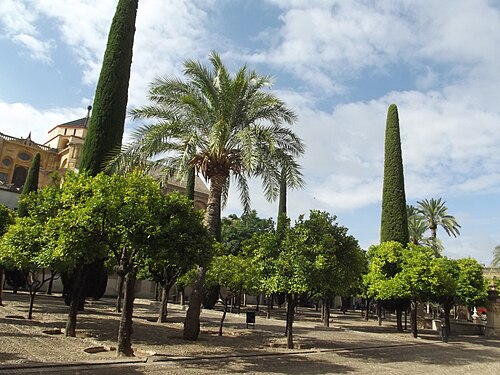
Ninety-eight bitter orange trees stand here in rows that line up with the columns of the prayer hall next door, so the courtyard reads as the building continuing outdoors into the light.
Photo: Elliott Brown (CC BY-SA 2.0)
Explore by city: Seville · Cordoba · Prague · Brussels · Porto · Brisbane · Munich · Cambridge · every city · or browse all species.