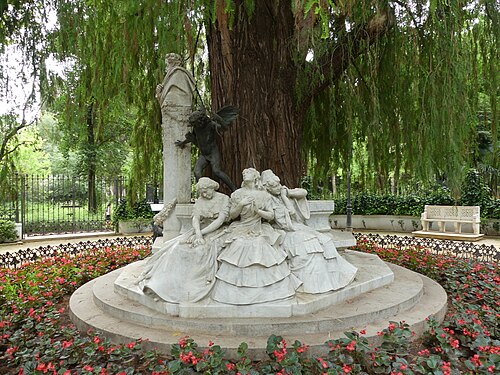
The Fig of the Glorieta de Goya
Parque de María Luisathe Parque de María Luisa
Two marble columns are the only physical trace left of the pavilion this fig tree now grows inside. The Glorieta de Goya, a circular clearing in Parque de María Luisa near Plaza de España, once held a full-scale replica of the Quinta del Sordo, Francisco de Goya's house outside Madrid, built for the 1929 Ibero-American Exposition and dismantled once the fair closed. Only two four-metre Doric columns from that pavilion's entrance survived the teardown, and they now frame a Moreton Bay fig planted in the same period, introduced to Seville in the early 20th century and naturalized well enough in the local climate that Ficus macrophylla now shows up across the city's parks and plazas. The tree has grown into the columns' role as much as around them, its crown now the dominant feature of a clearing designed to showcase a painter's house rather than a fig tree. Later redesigns in the second half of the twentieth century reshaped the glorieta's paths and plantings more than once, but the columns and the fig both survived every version. Visitors walking the park's central axis between Plaza de España and the fountain gardens pass directly beneath it, often without registering that the shade they're standing in used to be somebody's front garden reconstruction.
From people who stood here
No notes yet
Did you visit the tree? Leave a note for the next visitor.
Getting there
Glorieta de Goya, Parque de María Luisa, 41013 Sevilla
You can recognise it by two four-metre marble Doric columns framing its crown, the last trace of a demolished pavilion. It stands in the Glorieta de Goya, Parque de Maria Luisa.
5 min walk from Plaza de España, inside Parque de María Luisa
Sources
Where the facts on this page come from. The story was written with AI from these sources, and readers who know the tree correct it.