Raudonė, a village on the Nemunas beside a 16th-century castle, holds a seven-trunked lime in the castle park, voted Lithuania's Tree of the Year 2018. Local legend says it split into seven trunks after seven serfs were chained and whipped to death against it. Two more oaks widen the outing: the Plokščiai Oak, newly protected and once hollow enough for children to climb inside, across the Nemunas; and the Ilguva Oak, a longer detour off any marked path, put at 300 to 400 years by the state register.
0 of 3 visited in Raudonė
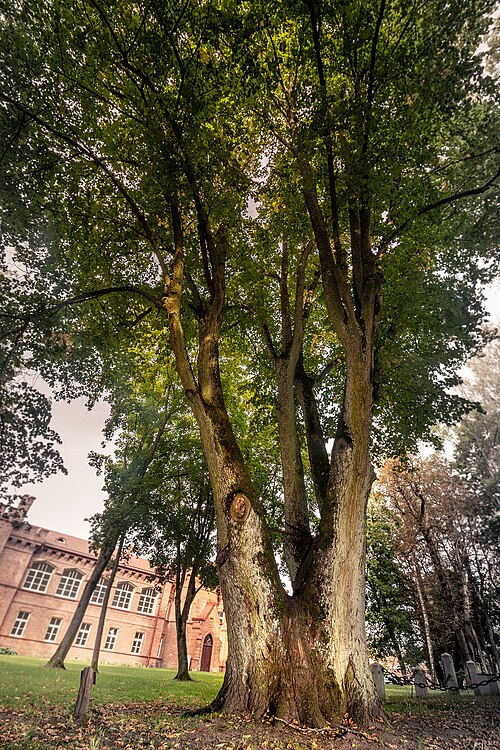
Small-leaved Lime (Tilia cordata) · 400 years · Raudonė, within Panemunių regioninis parkas (Panemunė Regional Park)
Seven trunks, and a legend that accounts for them in the worst way available. A metal rod sits embedded between two of the stems about three metres up, and local tradition holds that seven serfs were once chained to that rod and whipped to death, and that the lime split into seven from the horror of it. The Panemunė Regional Park repeats the story on its own pages as folklore rather than as record, which is exactly how to take it.
Strip the legend away and the tree still earns the drive. The state register puts it at about 400 years old. It measures 6.2 metres round at chest height and 31 metres tall, under an egg-shaped crown 20 metres deep and 19 across that shades some 220 square metres of ground. In 2018 the Lithuanian Arboriculture Centre named it Lithuania's Tree of the Year, on a nomination from the regional park, and in 2019 it went forward to the European Tree of the Year contest.
It stands about forty metres east of Raudonė Castle, beside a Soviet-era memorial to the Second World War. The castle itself is a primary school now, with a tower open to visitors for around a euro and a half; the park where the lime grows costs nothing and needs no ticket. The Nemunas runs below, and the regional park along with it.
Photo: Darius Petrulis (CC BY-SA 4.0)
Pedunculate Oak (Quercus robur) · Plokščiai, Panemunių regioninis parkas
Children in Plokščiai used to climb inside this oak. The base of the trunk rotted out long ago, leaving a hollow big enough to play in, and people who grew up in the village still remember doing it.
The hollow has not stopped it growing. It stands 34 metres tall, which is a great deal for an oak. The trunk is 5.2 metres round.
For all that, it had no official status until very recently. Lithuania's Environment Ministry designated it only in September 2025, in the same order that protected a wave of other big oaks across the country, including the Netoniai oak outside Kaunas. It is one of the eleven natural heritage objects of Panemunių Regional Park, the stretch of the Nemunas valley famous for its castles.
It grows on the south bank of the river, beside the Kentėjimo kelias, the Suffering Path memorial, near the road through Plokščiai village. That puts it about 2.8 kilometres by road from the Castle Lime at Raudonė on the far side of the valley, close enough to make the two a single outing. There is another Plokščiai oak in Kretinga district, near Klaipėda; this is not it.
Nobody has published an age for this tree. If you know how old it is, tell us.
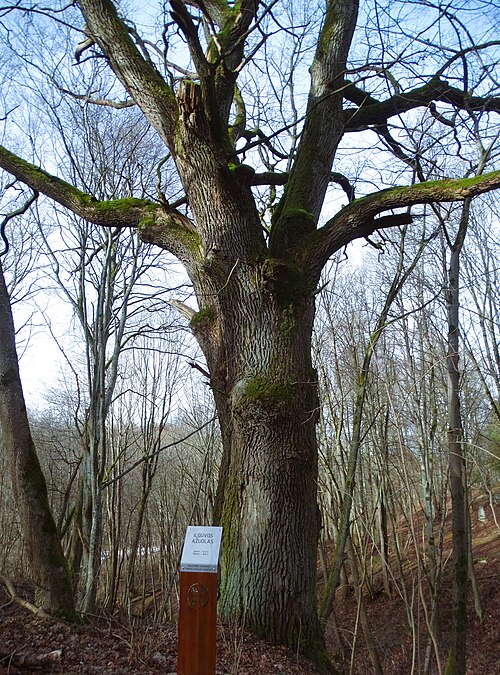
Pedunculate Oak (Quercus robur) · 300-400 years · Ilguva, Nykos kraštovaizdžio draustinis
This is the oak you have to look for. It stands off any marked path on a slope in the Nykos landscape reserve, and the usual way in is on foot along the Nyka stream from the village of Dulinčiškiai, then up the bank. The pin gets you close; the last stretch is yours.
What you find is worth the scramble. The trunk is 5.42 metres round at chest height, measured in 2014, and at 3.8 metres it splits into three stems that carry the tree to 32 metres. The crown alone is 22 metres tall and 22 metres wide, as broad as it is deep.
The state cadastre puts it at 300 to 400 years old. That range is the register's own, not something we worked out, and it has been protected since 2005. Even the low end means this oak was already growing on its slope when the Nemunas valley below was still part of the Grand Duchy of Lithuania.
It is 12.7 kilometres from Raudonė by road, a longer detour than the Plokščiai oak across the river, and best treated as a small expedition of its own; Ilguva's church, about 130 metres to the north, is the landmark to aim for. Everything here rests on one published source, the cadastre as Lithuanian Wikipedia reports it. If you find the tree, a photograph and a word about the way in would help the next person.
Photo: Vilensija (CC BY-SA 3.0)