Four trees, and three of them are at Morris Arboretum. Bartram's Ginkgo, the oldest ginkgo in America, grows alone at Bartram's Garden on the Schuylkill, planted in 1785 by William Hamilton and outliving the two he kept for himself. Across town at Morris Arboretum stand a natural oak hybrid nobody bred, a katsura whose autumn leaves smell of brown sugar, and a weeping hemlock that survived a world's fair, a 1947 move, and the 2024 storm that killed its twin.
0 of 4 visited in Philadelphia
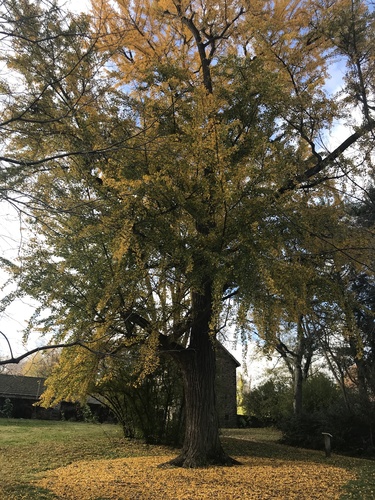
Ginkgo (Ginkgo biloba) · 240 years · Southwest Philadelphia (Kingsessing)
In 1785, William Hamilton shipped three ginkgo saplings from London, the first of their kind to reach North America. He planted two at his own estate, The Woodlands, and gave the third to his friend William Bartram, whose garden a few miles up the Schuylkill was already the oldest botanic garden on the continent. Hamilton's two are gone, felled in the 1980s. Bartram's is the one that made it.
That leaves this tree, standing east of the old barn on the same ground Bartram himself planted, as the oldest ginkgo known in America at roughly 240 years old. It is male, which spares the garden a problem: ginkgoes are dioecious, and only the females drop the soft, foul-smelling seed that gives the species its reputation at street level. Whoever decided which sapling went where left Bartram with the tidier tree.
The 1785 date is well attested. Wikipedia and the garden's own institutional history agree closely on it, though both likely trace back to the same original record rather than two truly independent counts, worth knowing before treating the figure as beyond question. No exact coordinates for the trunk have ever been published, so the pin here marks the general area rather than the base of the tree itself.
Bartram's Garden is free, city owned, and open every day from dawn to dusk.
Photo: Andrew Conboy (CC BY)
Bender Oak, a natural hybrid of Scarlet Oak x Northern Red Oak (Quercus x benderi) · 150-250 years · Chestnut Hill, Philadelphia
Nobody bred this oak. It is a cross between a scarlet oak and a northern red oak that happened on its own, the kind of hybrid botanists did not even get round to naming until 1903, in Breslau. The one at Morris Arboretum may be up to 250 years old, which would put it at roughly the age of the United States. The arboretum's own guide says possibly; the lower end of the honest range is nearer 150.
It is also big in the way that matters: 26.5 metres tall, a trunk more than two metres across, and a canopy spreading over 30 metres. The Morris family, whose estate became the arboretum, had it as the dramatic entrance to their garden and their home on the hill. Today it is the first stop on the arboretum's own Great Trees tour.
There was once another notable Bender oak in the Philadelphia area, at Swarthmore College, reckoned at over 350 years. It was felled some time before 2009. This one is still standing, a hybrid most visitors have never heard of in a spot where they expect an ordinary oak.
It stands near the old mansion site at the start of the garden. Entry to the arboretum is paid. The pin is approximate; follow the Great Trees tour to stop one.
Katsura (Cercidiphyllum japonicum) · 124 years · Chestnut Hill, Philadelphia
Philadelphia Magazine once called this the largest tree in Philadelphia, which is a bold thing to say about a tree barely 120 years old. It is a katsura, native to Japan and China, planted around 1902 by the Morris family on the estate that became Morris Arboretum, and it has grown into one of the largest of its kind in North America.
The arboretum calls it its signature tree, and it earns the title in two ways. The first is plain size. The second arrives in autumn, when the leaves turn yellow and apricot and the air under the crown starts to smell of cinnamon and brown sugar, a bakery where you expected a garden.
In the century and a bit since it went in, the Morris estate around it has become a public garden run by the University of Pennsylvania, and a family planting has become the tree the arboretum puts forward as its emblem. It is stop seven on the arboretum's own Great Trees tour.
Entry to the arboretum is paid. The pin marks the arboretum rather than the tree, so follow the tour to stop seven, and in October let your nose help.
Eastern Hemlock (Tsuga canadensis) · 150 years · Chestnut Hill, Philadelphia
This weeping hemlock was a celebrity once. In 1876 it went on show at the Centennial Exposition in Fairmount Park, the world's fair that marked America's hundredth birthday, where the Parsons & Sons nursery exhibited weeping hemlocks and, by the arboretum's account, created a sensation among horticulturists.
Two of those exhibition hemlocks came to the Morris estate afterwards. One was planted near the pond. The other went in near the Key Fountain, and in 1947 it was dug up and moved to a new home at the Meadowbrook Avenue gate. Moving a tree of that age is a gamble. It worked.
The twin by the pond was not so lucky. On 13 February 2024 a wet, heavy snowstorm brought it down, and the arboretum wrote its obituary. If you are carrying the older printed Great Trees brochure, its stop eleven describes that pond tree, which is gone. The survivor is this one, at the gate.
It is a weeping form of the eastern hemlock, the branches falling rather than reaching, and at roughly 150 years, counted from its first public appearance in 1876, it has now outlived both its sister and the fair that made it famous.
Entry to the arboretum is paid. The pin is approximate; head for the Meadowbrook Avenue gate.