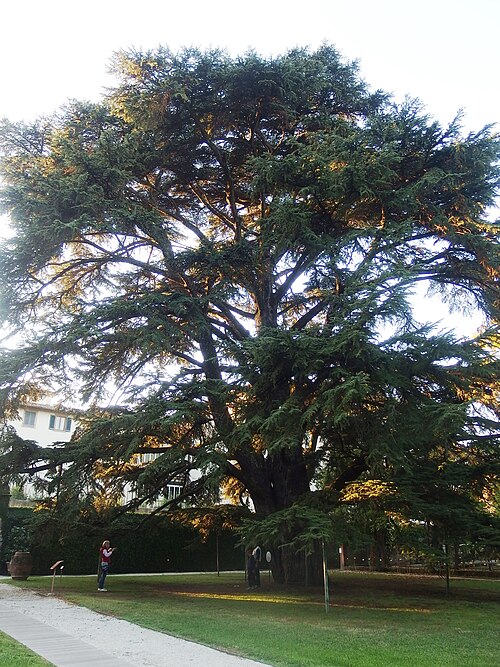
In fruit
This tree is two years younger than the garden around it.
Photo: Palickap (CC BY-SA 4.0)
Lucca, Italy
Lucca's botanical garden was founded in 1820 by Maria Luisa di Borbone, Duchess of Lucca, and its early directors recorded exact planting dates for several of these trees.
A cedar of Lebanon and a Corsican pine went in together in 1822; a redwood arrived around 1850, one of the first raised in Europe; a ginkgo, felled by lightning, regrew as three trunks from one root. By the pond, a pair of bald cypresses throw up woody knees from the water and turn rust orange each autumn, the garden's only conifer that behaves like a deciduous tree. Nearby, a seven-metre Balearic box grows to a size the species rarely reaches outside its native islands, next to the garden's youngest registered tree, a silver lime planted around 1900, and a fastigiate yew whose thickness belies how slowly the species grows. The garden charges standard admission.
This tree is two years younger than the garden around it.
Photo: Palickap (CC BY-SA 4.0)
The garden has two oldest trees and only one of them is famous.
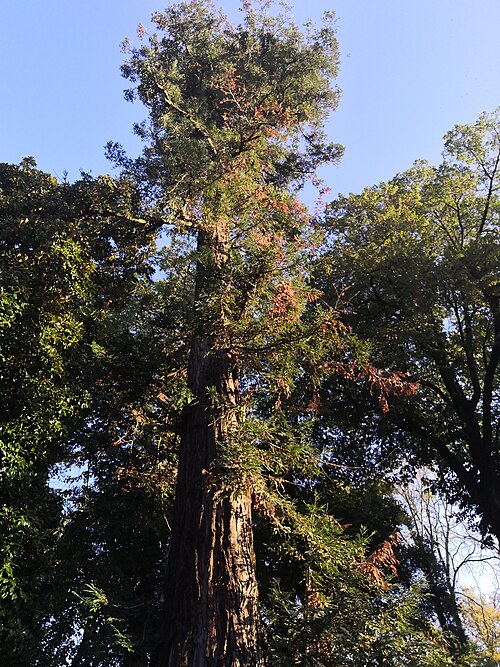
The tallest living thing inside Lucca's walls is Californian.
Photo: Palickap (CC BY-SA 4.0)
Lightning took this tree down after the war and it came back as three.
Box is usually a hedge plant, clipped into shapes barely taller than a person.
The youngest tree the register protects in Lucca's botanical garden stands sixty metres from one of its slowest growing: a silver lime planted around 1900, its leaves silvery on the underside and t...
Two bald cypresses stand fifteen metres apart at the pond in Lucca's botanical garden, buttressed at the base and throwing up the woody knees that let the species breathe in waterlogged ground, a t...
More parks worth the walk: every park we map. Or explore by city: Prague · Brussels · Porto · Brisbane · Munich · Cambridge