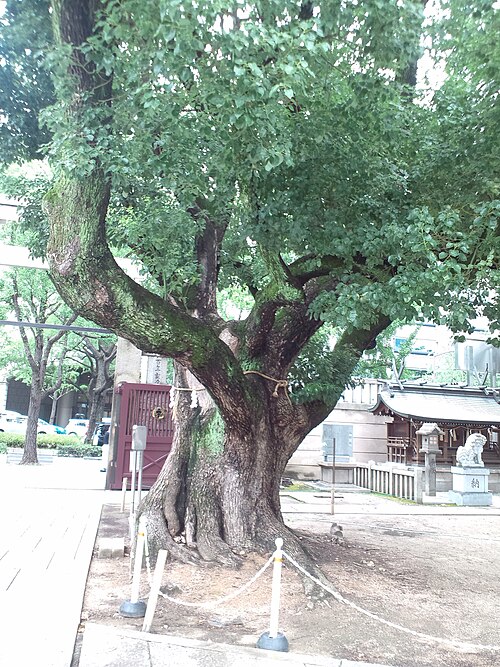
Lightning found this camphor sometime during the Taisho era, between 1912 and 1926, and burned out most of its main trunk. What survived was roughly a third of the original tree, its supporting limbs still living beneath a long dead spar from the original trunk, enough that a tree doctor could eventually nurse it back into something recognisably whole. What stands today at Achihayao Shrine is that survivor: about six metres around, sixteen metres tall, and by tradition close to 1,000 years old. Osaka Prefecture designated it a natural monument in 1970 under the plain name the Camphor of Achihayao Shrine, one of the few individually protected trees left in Tsurumi Ward. The shrine itself appears in the Engishiki, the 10th-century register of officially recognised shrines, which places worship on this exact spot at least a thousand years back, roughly matching the tree's own traditional age. Unlike Sumiyoshi Taisha's better-known camphors across the city, Achihayao draws a quieter crowd: local families and anyone who has read that this is one of the only trees in Osaka that visibly carries its own near-death on its trunk. Most ancient trees hide their age. This one wears it as a scar, three minutes from a suburban train station most visitors to Osaka never have a reason to use.
From people who stood here
No notes yet
Did you visit the tree? Leave a note for the next visitor.
Getting there
Achihayao Shrine, 3-31-18 Hanaten-higashi, Tsurumi-ku, Osaka
You can recognise it by the long dead spar of its original lightning-burned trunk beside the living limbs that grew back. It stands at Achihayao Shrine, three minutes from the nearest suburban station.
3 min walk from Hanaten Station (JR Gakken Toshi Line / Osaka Metro Imazatosuji Line)
Sources
Where the facts on this page come from. The story was written with AI from these sources, and readers who know the tree correct it.